eCommerce Integration Services
Connect <abbr title="Enterprise Resource Planning">ERP</abbr>, <abbr title="Product Information Management">PIM</abbr>, <abbr title="Order Management System">OMS</abbr>, CRM, payments and logistics through owned data flows. We design for recovery as well as the happy path.
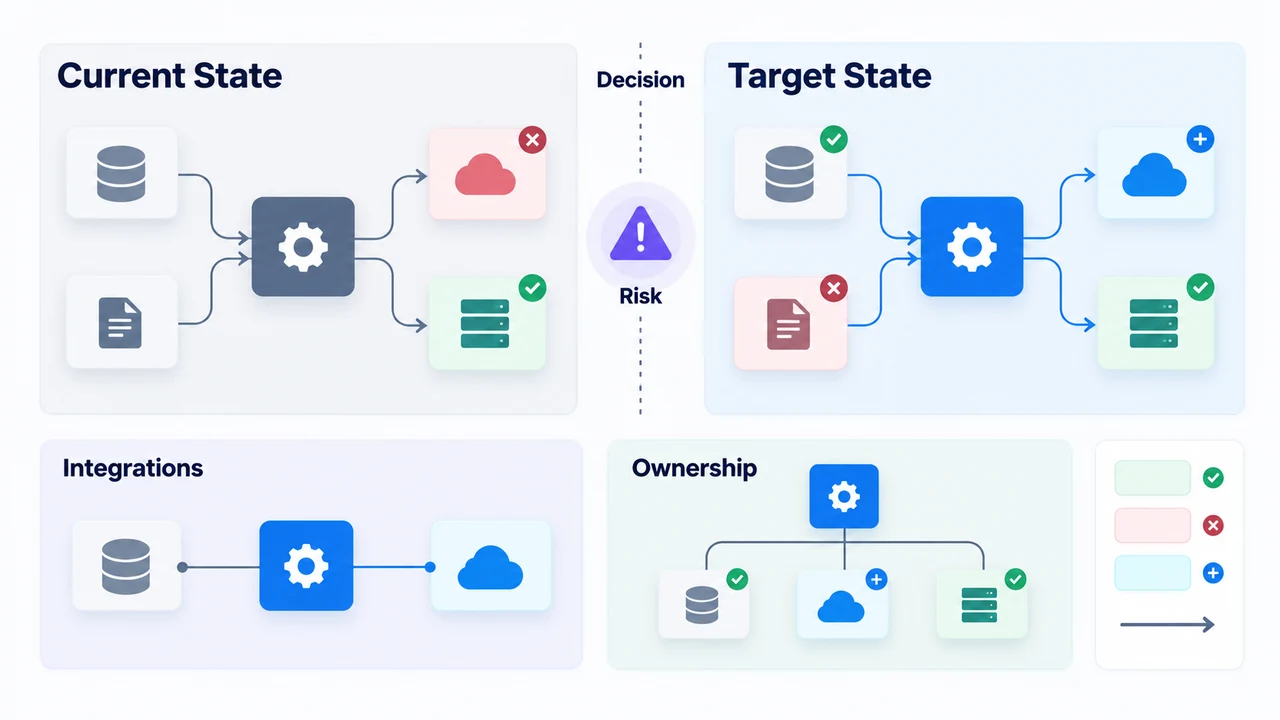
Start with the business transaction and its owner.
- Typical first step
- Map one high-cost workflow end to end.
- Inputs we need
- Systems, owners, representative payloads, volumes, failure examples and access constraints.
- Outputs
- Source-of-truth map, contracts, delivery backlog and operating model.
- Working format
- Workshops with process owners plus focused engineering delivery.
Turn point-to-point connections into owned data flows.
- Different systems disagree on inventory or order state.
- Retries create duplicates or hide partial completion.
- Batch jobs fail without a clear recovery owner.
- Schema changes break downstream consumers.
- Each data domain has a named source of truth.
- Commands are idempotent and state changes are explicit.
- Retries, dead letters and reconciliation have procedures.
- Contracts and compatibility rules protect consumers.
The contract matters more than the connector.
Sync, async and batch patterns can coexist. We choose by consistency need, failure cost, volume and recovery behaviour.
Synchronous
Use when the caller needs an immediate authoritative answer.
Define timeout, fallback and partial-failure behaviour.Asynchronous
Use for durable workflows and independent processing.
Define ordering, idempotency, retry and dead-letter ownership.Batch / scheduled
Use for bulk exchange or systems without event APIs.
Define watermarking, validation, reconciliation and reruns.Integration scope from ownership to cutover.
System-of-record mapping
Ownership for product, price, stock, customer and order data.
Boundary: Business ownership must be named by the client.Contracts and schemas
Versioned payload and compatibility rules.
Boundary: Third-party API limits remain external constraints.Workflow orchestration
State transitions across commerce and operations.
Boundary: Business policy approval stays with process owners.Resilience controls
Idempotency, retries, dead letters and replay.
Boundary: No SLA is implied without a separate agreement.Cutover and reconciliation
Migration, parallel run and discrepancy handling.
Boundary: Source-data repair is scoped separately.Monitoring and ownership
Dashboards, alerts and failure routing.
Boundary: 24/7 response is excluded unless contracted.Integrate each commerce system around a clear owner.
ERP, PIM and OMS integrations are distinct data and workflow boundaries, not one connector bundle.
- ERP: orders, prices, inventory, customers and financial handoff.
- PIM: product content, attributes, enrichment and publication.
- OMS: order state, allocation, fulfilment, cancellation and reconciliation.
Map → Contract → Prove → Operate
Map
Workflows, owners, payloads and failure examples.
Trace data and decisions across systems.
Source-of-truth and failure map.
Contract
Rules, volumes and consumer constraints.
Define schemas, states and recovery semantics.
Versioned contracts and test cases.
Prove
Access, test data and cutover constraints.
Build thin flows and exercise failure modes.
Verified integration slice and cutover plan.
Operate
Production signals and ownership model.
Add monitoring, replay and reconciliation procedures.
Runbook and improvement backlog.
Example failure-ownership register.
Illustrative structure only — not a client case or a performance claim.
01Duplicate commandDetect by idempotency key · owner: integration
02Rejected payloadQuarantine and notify · owner: source system
03Downstream timeoutRetry then dead letter · owner: operations
04State mismatchReconcile against source of truth · joint review
Outputs
Included
- 01System context and ownership map
- 02API or event contracts
- 03Failure-mode catalogue
- 04Reconciliation specification
- 05Cutover and rollback checklist
- 06Operational runbook
Team shape
An integration architect, backend engineers, quality specialist and source-system owners; the mix follows the flows and failure modes.
Code and IP
The client owns the project-specific code and agreed deliverables after payment; third-party licenses and pre-existing tools keep their original terms.
Handoff and support
Handoff includes agreed repositories, documentation and knowledge transfer. Ongoing support is a separate scope unless included in the engagement.
Not included by default
Replacement of ERP/PIM/OMS/CRM products, correction of all source data and continuous on-call support unless separately scoped.
Price factors
Systems and workflow count, API quality, data volume, consistency needs, historical migration, test environments and cutover constraints.
What affects eCommerce integration cost and delivery time?
The number of connectors is only one input. Unknown data ownership and untestable failure paths usually create more risk than the transport technology.
| Factor | Effect on scope | Evidence needed |
|---|---|---|
| Business workflows | Orders, inventory, products, prices, customers and returns have different consistency and recovery needs. | End-to-end scenarios, decision owners and costly exceptions. |
| Interface quality | Stable APIs differ materially from files, database access or vendor-limited endpoints. | Contracts, payload samples, limits, authentication and sandbox access. |
| Volume and latency | Peak throughput, batch windows and freshness targets determine sync, async or scheduled patterns. | Peak volumes, payload sizes, acceptable delay and seasonal profile. |
| Data quality and history | Duplicates, missing identifiers and historical migration add mapping and reconciliation work. | Source samples, identifiers, retention rules and known discrepancy rates. |
| Cutover and operations | Parallel runs, replay, alerts and support ownership shape release effort. | Cutover window, rollback policy, named responders and support boundary. |
Example data-flow ownership matrix
An illustrative discovery artifact—not a description of a client implementation. Actual direction, freshness and ownership are verified for each system.
| System | Data | Direction | Source of truth | Sync pattern | Failure handling |
|---|---|---|---|---|---|
| PIM | Product content and attributes | PIM → commerce | PIM | Events or scheduled delta | Quarantine invalid records; report field errors |
| ERP | Prices and available-to-promise stock | ERP → commerce | ERP | API plus scheduled reconciliation | Timestamp stale data; reconcile by SKU and account |
| Commerce | Submitted order | Commerce → OMS / ERP | Commerce until accepted | Idempotent command | Retry safely; route rejected orders to an owned queue |
| OMS | Allocation, shipment and cancellation state | OMS → commerce | OMS | Events with replay | Detect missing transitions; reconcile order state |
| CRM | Company and contact eligibility | CRM ↔ commerce | Named per field | API or controlled batch | Reject ambiguous identity matches; preserve audit |
Start with one business transaction and its owner.
Which systems can you integrate?
ERP, PIM, OMS, CRM, payment, tax, logistics and marketplace systems where supported interfaces or controlled data exchange are available.
How do you prevent duplicate orders?
By combining idempotency keys, explicit state transitions, durable processing and reconciliation.
Do we need to replace existing systems?
Not by default. We first clarify ownership and improve the boundaries around systems that should remain.
Who handles failures after launch?
The operating model names the first responder and escalation path; ongoing response coverage requires an explicit support agreement.
Start with one business transaction and its owner.
After contact we trace its systems, data and failure paths, then define the next useful step.
Review an integration →