The brief describes screens, not the business
Catalogue ownership, fulfilment and system boundaries get discovered mid-project instead of planned for. Every gap like that turns into a change request later, at a worse price.
eCommerce store development
Most builds start with a platform and hope the business fits around it. We start with your catalogue, your customers and your operations — then decide what the store needs to be built on.
WHERE STORE PROJECTS LOSE MONEY
Catalogue ownership, fulfilment and system boundaries get discovered mid-project instead of planned for. Every gap like that turns into a change request later, at a worse price.
Then the business spends the next two years working around a decision that was made in the first week, because reversing it means starting over.
Products, customers and order history get dumped in days before launch, and nobody checks what actually came through intact until a customer complains.
The team that built the store leaves, and yours is left guessing how to run what was just handed over.
OUR APPROACH
This is the first decision, before any vendor name comes up: how much of the store should be standard, and how much genuinely needs to be yours. We build custom only where your business doesn't fit anything off the shelf — not because a platform is fashionable or unfamiliar. Which specific platform fits best is a separate question, one we answer in platform selection.

A commerce platform suited to your catalogue and operations covers checkout and day-to-day work without modification, so you launch faster and inherit a large ecosystem of ready-made extensions.
Customisation stays within limits the platform can safely upgrade through.The storefront experience or a few specific capabilities — search, pricing, a custom frontend — need to evolve independently, while everything else runs on stable, proven components.
This only works with clear contracts between the parts, and someone who owns keeping them in sync.Your pricing logic, buying rules or operating workflow are different enough that no platform supports them without workarounds that become their own maintenance burden — so we build exactly that piece.
We don't rebuild catalogue, checkout or other standard functions from scratch just because something custom is already underway.WHAT ACTUALLY GETS BUILT

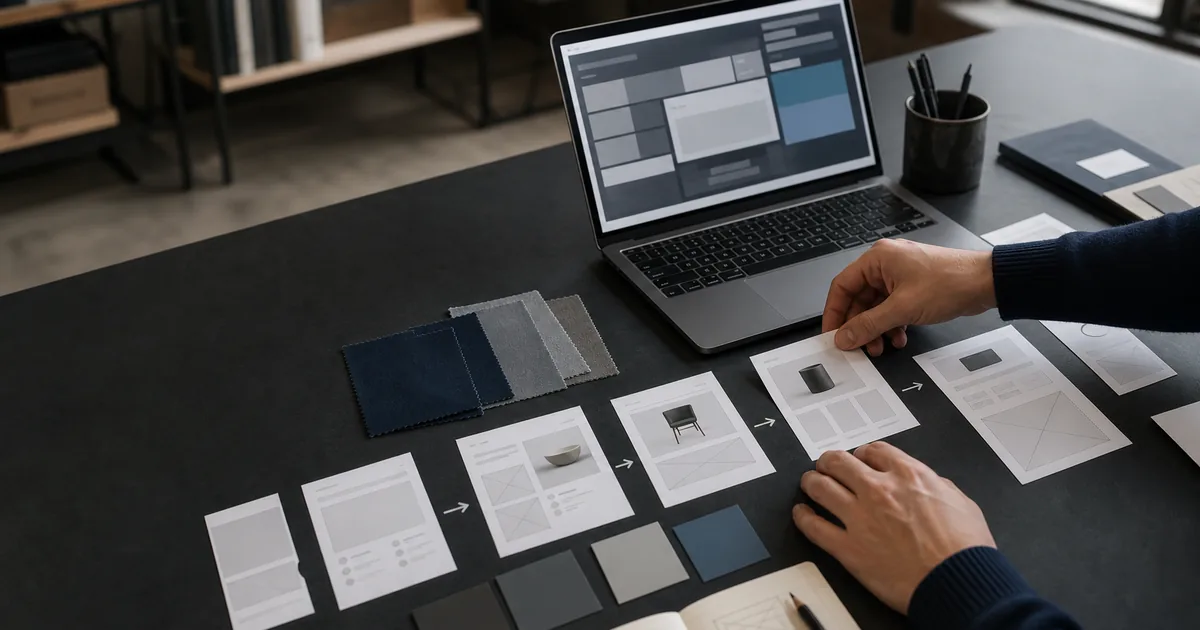
We map how customers discover, evaluate and buy — browsing and guest checkout for consumers, alongside company accounts, negotiated pricing and repeat ordering for business buyers, on the same catalogue. Every page gets a layout built around your real products, including the states real shoppers hit: empty search results, an out-of-stock item, a checkout error.
Brand identity — logo, colour system, tone of voice — is a separate track unless you ask us to build it.Products, variants, pricing rules, promotions and the full cart-to-checkout flow are built to match how you sell, discount stacking and tax rules included. Payments, ERP, PIM, OMS, CRM and shipping providers get connected with a clear owner for every data flow, so orders, stock and customer records don't quietly drift apart.
Replacing one of your existing source systems is a separate, explicitly scoped project.Existing products, customers, orders and content are mapped field by field and migrated into the new store in a rehearsed run, then checked against the original before anything goes live. We plan the cutover window, a tested rollback path, and a handoff that leaves your team able to run the store without waiting on us for every change.
Ongoing, indefinite support is not included unless you ask for it separately. This covers moving your data — deciding whether to change platforms at all is a separate question.HOW WE WORK
Your business model, target customer journeys, catalogue and day-to-day operations, as they exist today.
We define exactly what is in scope, who owns which decision, and the criteria for choosing platform, hybrid or custom.
A solution brief and risk map you can review before any build work starts.
The approved direction from Model, plus your content, brand assets and the systems we need to integrate with.
We design the actual customer and admin journeys, decide where data boundaries sit, and sequence the release plan.
A full experience and solution specification — what gets built, and in what order.
Environment access, realistic test data, and a backlog ordered to prove the riskiest assumptions first.
We build complete customer journeys end to end — not isolated screens — with integration and regression tests running alongside.
Working increments of the actual store, plus test evidence you can review as we go.
An accepted scope, a rehearsed migration, and named owners for cutover decisions.
We execute the cutover, verify every critical journey against the checklist, and walk your team through how the store runs.
A launch record, a clean handoff, and an explicit boundary for what support looks like afterward.
FREQUENTLY ASKED
Yes — often on the same platform. The key is making account structures, contract pricing, approval workflows and checkout rules explicit for each audience before we start building, so one does not quietly break the other.
No. We compare platform-led, hybrid and fully custom approaches against what your business actually needs to own, and recommend accordingly — sometimes that's a standard platform with no changes needed, sometimes a custom checkout on top of it.
You do. Once payment is complete, you own the project-specific code and agreed deliverables outright, subject to the terms of any third-party licences or pre-existing components.
We complete the handoff we agreed on — documentation, access, knowledge transfer — plus whatever post-launch support window was scoped in. Ongoing support beyond that is a separate agreement, not an assumption.
Tell us what you sell and how — we'll tell you what it actually takes to build, and what it doesn't.
Discuss your store →Already know you need a platform, just not which one? See platform selection & replatforming →