
eCommerce App Development: Process, Features, and Cost
Core app features, architecture options, implementation stages, and budget factors.
An eCommerce app should solve a repeat customer problem that a responsive website cannot solve as effectively. Faster reordering, loyalty, barcode scanning, store assistance, saved preferences, and timely account updates can justify installation. Reproducing the website in an app rarely does.
eCommerce app development is product development: it requires a clear audience, dependable commerce services, measurable adoption goals, and an ongoing release plan.
Decide whether an app is necessary
Review mobile web behavior, purchase frequency, retention, authentication, and support requests. An app is more likely to create value when customers return frequently, use account-specific functions, need device capabilities, or engage across online and physical channels.
If most customers make infrequent purchases through search, improving the mobile website may produce better reach at lower cost. A progressive web app can provide selected app-like behavior, although platform and device support varies.
Prioritize a focused feature set
Core features normally include discovery, search, product information, cart, checkout, payment, account, order status, and support. Depending on the model, useful differentiators may include:
- biometric sign-in and secure session recovery;
- saved carts, wish lists, subscriptions, and rapid reordering;
- barcode or visual search;
- loyalty cards and store-specific offers;
- push notifications for meaningful order or availability events;
- location-aware pickup and inventory;
- offline access to selected account or catalog information.
Do not use notifications as a substitute for relevance. Ask permission in context and give users granular controls.
Native, cross-platform, or web-based?
Native iOS and Android development offers deep platform integration and control, but requires parallel skills and release work. Cross-platform frameworks can share substantial code while retaining app-store distribution and device access. Web and progressive approaches simplify deployment and reuse web capabilities.
Choose based on required device features, performance, team expertise, accessibility, release cadence, and lifetime maintenance—not on fashion.
Commerce architecture
The app should not recreate pricing, promotion, inventory, tax, and order logic separately from other channels. Expose stable commerce APIs and define how identity, cart, catalog, checkout, and orders remain consistent across app and web.
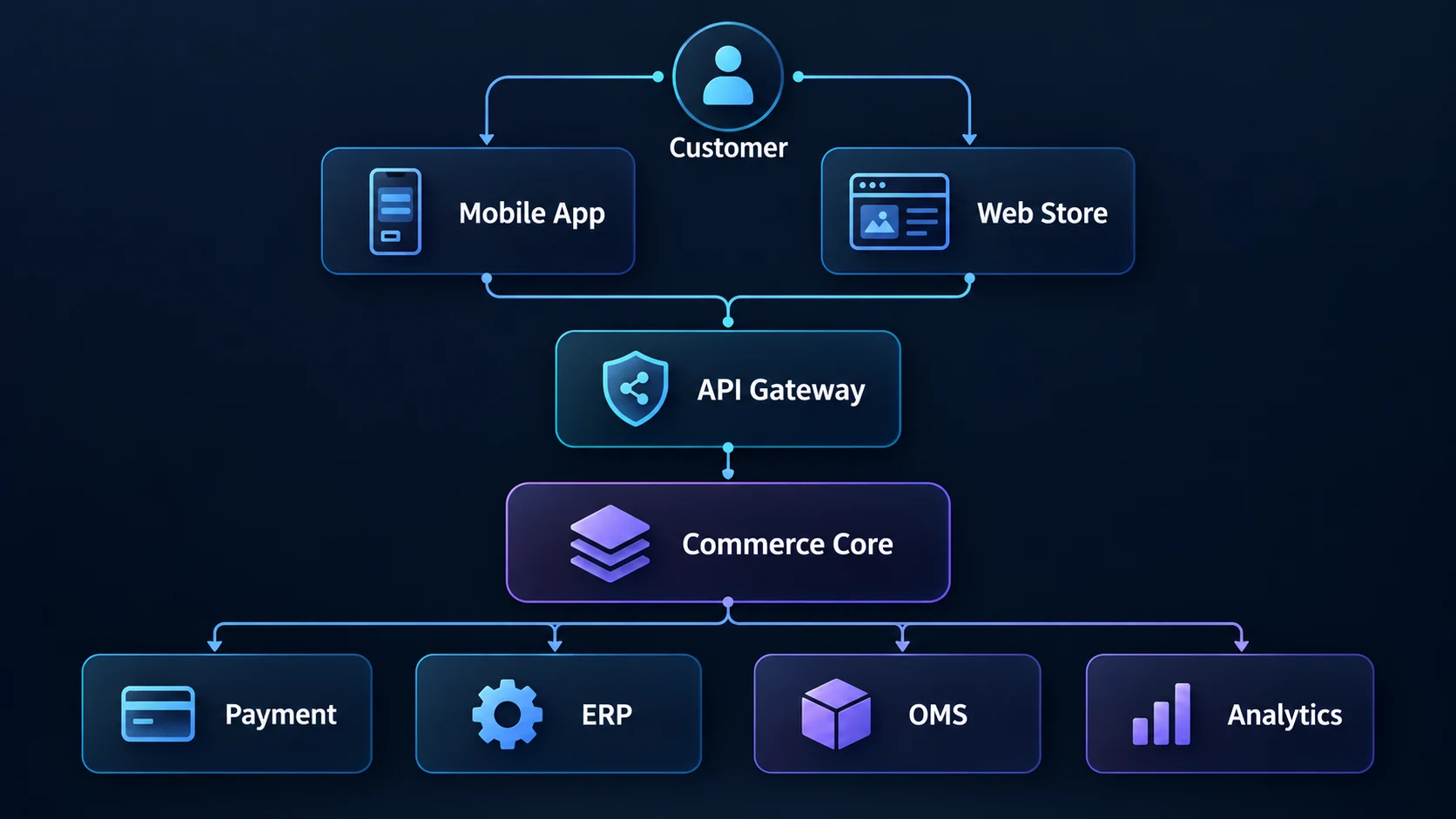
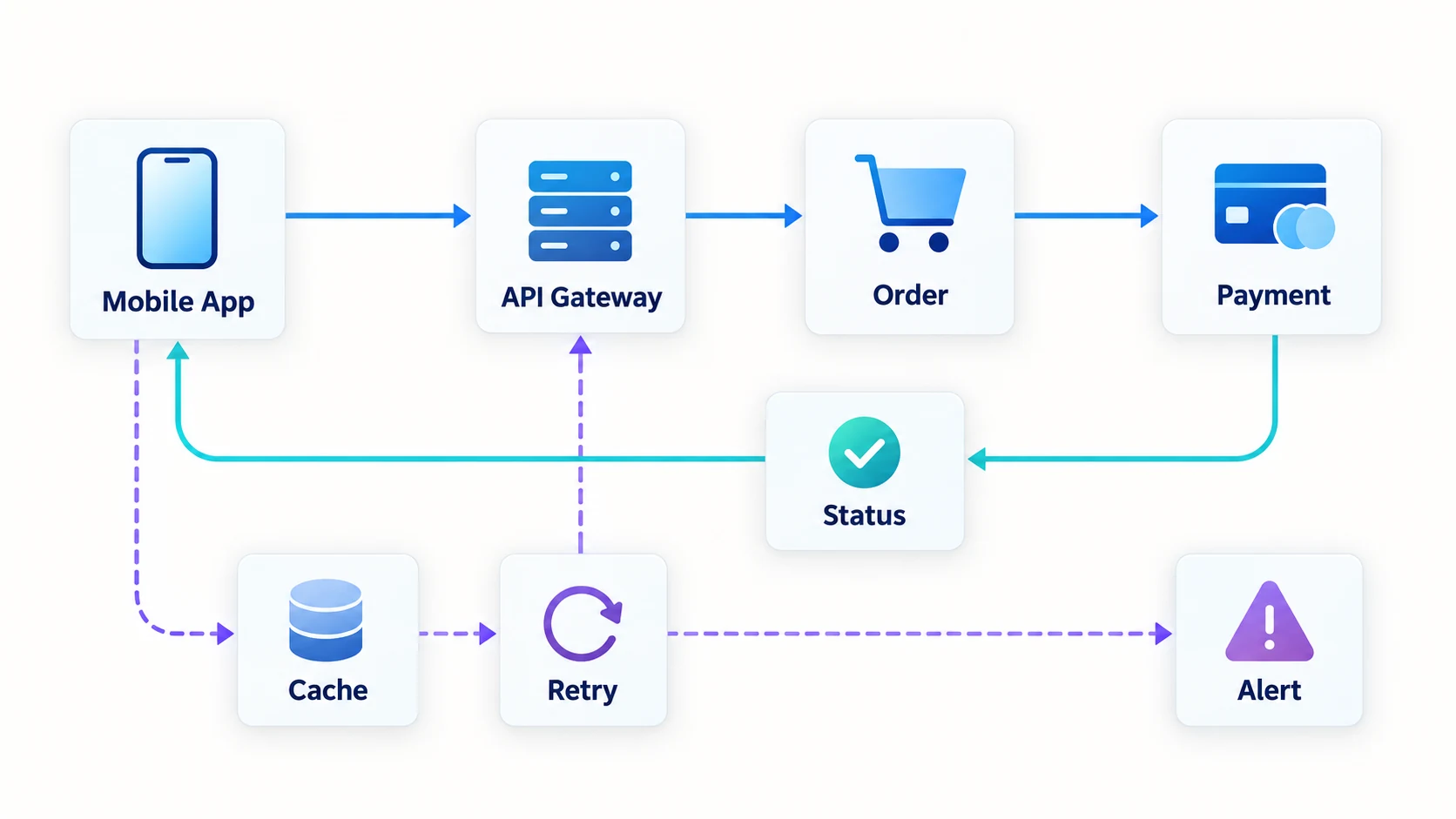
Use secure server-side services for sensitive operations. Design APIs for mobile latency, retries, pagination, and version compatibility. Cache carefully: a fast stale price or inventory promise can create a worse experience than a transparent wait.
Payments, security, and privacy
Use established payment providers and platform-supported wallets where appropriate. Minimize payment-data exposure and follow provider and app-store requirements.
Protect tokens and personal data, use secure storage, enforce authorization server-side, detect unsafe sessions, and support account deletion and consent requirements. Threat modeling should cover account takeover, promotion abuse, automated purchasing, tampered clients, and exposed APIs.
UX for mobile commerce
Design for one-handed use, small screens, interruptions, and variable networks. Keep navigation predictable, forms concise, touch targets adequate, and layouts stable. Preserve cart and checkout state when authentication or payment redirects interrupt the flow.
Test assistive technologies, dynamic text, contrast, focus order, and error announcements. Accessibility must survive native components and embedded web views.
Development process
- Validate the user problem and define adoption and retention measures.
- Map journeys and prioritize the smallest useful release.
- Choose architecture and API contracts.
- Prototype uncertain interactions with representative users.
- Build analytics, crash reporting, and feature controls from the start.
- Test devices, OS versions, networks, payments, and failure states.
- Run a controlled beta and prepare store-review assets and support.
- Release gradually, monitor, and improve from evidence.
What affects eCommerce app development cost?
Cost depends on platforms, design depth, commerce APIs, feature complexity, integrations, offline behavior, security, migration, testing devices, and ongoing releases. Existing reliable backend services can reduce app scope; fragmented legacy systems can increase it substantially.
Budget for app-store maintenance, operating-system changes, monitoring, analytics, customer support, security updates, and product improvement after launch.
Release and lifecycle planning
Mobile versions remain in use after a new release. Define supported versions, backward-compatible APIs, forced-update rules, feature flags, and deprecation. Keep critical commerce changes operable while store review is pending.
Instrument onboarding, search, checkout, payment recovery, and repeat use alongside crash, latency, and API-error signals. Support diagnostics should identify app version, operating system, and transaction correlation without exposing personal data or secrets.
Choosing an app development company
Look for commerce-domain knowledge as well as mobile expertise. Ask how the team maintains consistency with the web store, secures APIs, handles app versions, measures retention, and supports releases.
Flexor provides eCommerce application development for custom commerce workflows and connected systems. Explore all eCommerce development services and learn about the engineering team.
Responsive web, cross-platform, or native app
| Approach | Responsive web/PWA | Cross-platform app | Native apps |
|---|---|---|---|
| Reach | Immediate web access | App stores with shared code | App stores by platform |
| Device integration | Limited to browser APIs | Broad through framework | Deepest |
| Delivery overhead | Lowest | Moderate | Highest |
| Best fit | Occasional purchase | Frequent multi-platform use | Device-critical experience |
Frequently asked questions
How long does it take to build an eCommerce app?
A focused first release may take several months. Backend readiness, feature scope, platforms, integrations, design validation, and store review affect timing.
Should an app use the same backend as the website?
Usually, shared commerce services improve consistency. Channel-specific presentation can differ while products, prices, inventory, customers, and orders follow common rules.
Is cross-platform development suitable for commerce apps?
Often yes. Validate required device features, performance, accessibility, team skills, and long-term maintenance before deciding.
How is app success measured?
Track activation, repeat use, retention, purchase completion, crash-free sessions, task success, support demand, and incremental value—not downloads alone.
When does an eCommerce app justify its cost?
When repeat usage, loyalty, device capabilities, personalization, or operational workflows create measurable value beyond a strong mobile website.
Should the app call the commerce platform directly?
Usually a controlled API or backend-for-frontend is safer because it stabilizes contracts, protects credentials, and coordinates data from multiple systems.