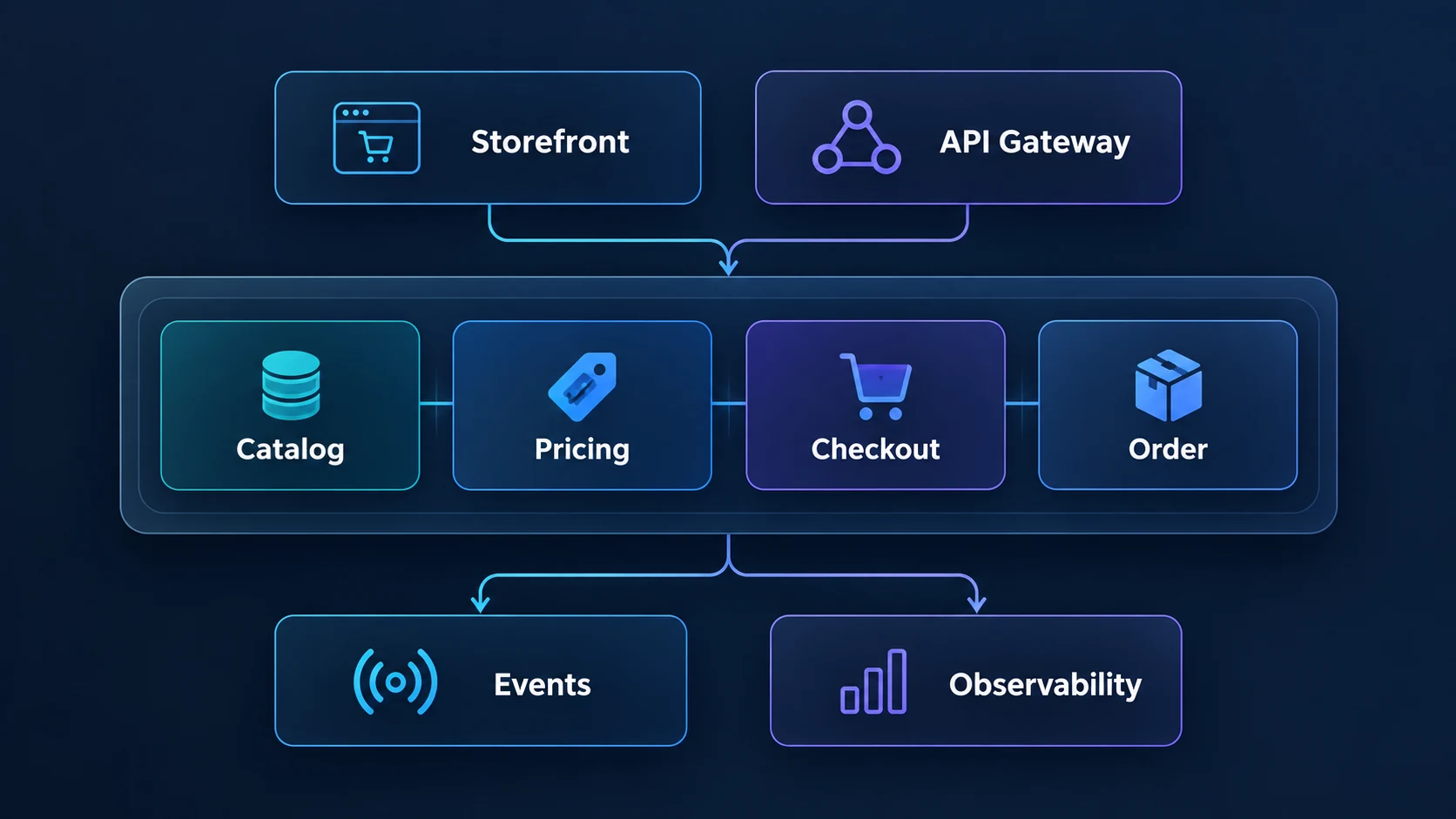
Custom eCommerce Platform Development: When It Makes Sense
When off-the-shelf tools restrict growth and custom software becomes justified.
Custom eCommerce development is justified when standard platforms force the business to compromise on essential workflows, economics, or ownership. It is not a synonym for quality, and it should not be chosen merely to make a storefront look distinctive.
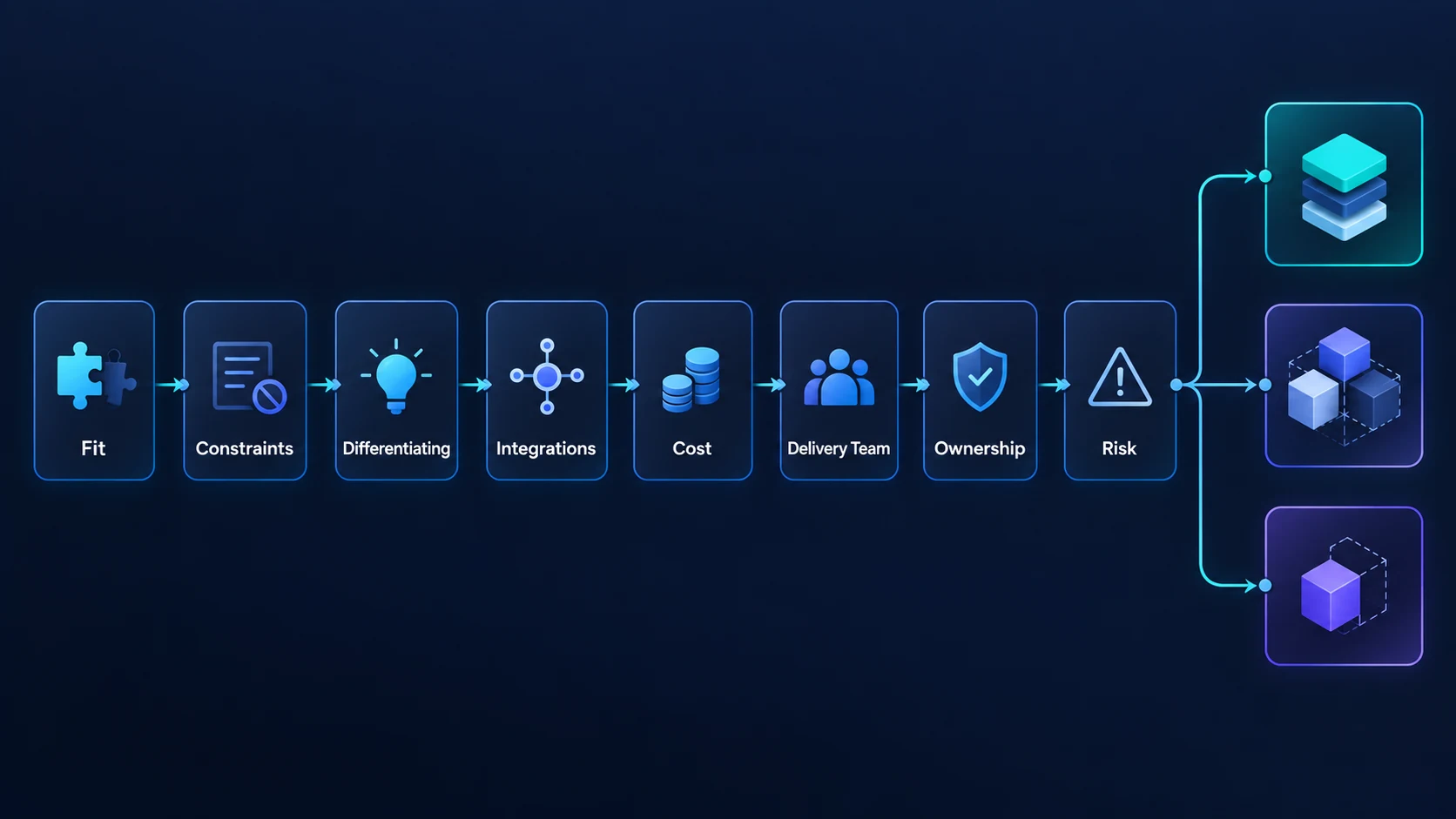
The decision is architectural: which capabilities create enough value or reduce enough operational friction to warrant owning more software?
What is a custom eCommerce platform?
A custom eCommerce platform is software designed around a company’s specific catalog, customer journeys, transactions, and operations. It may be fully bespoke or composable, combining custom services with proven products for payments, search, content, identity, or order management.
“Custom” should describe the business capabilities you own—not an unnecessary rewrite of commodity functions.
When standard platforms are the better choice
Hosted and open-source platforms provide mature catalog, promotion, cart, checkout, administration, and ecosystem features. They are often the strongest option when requirements are conventional, speed matters, and the business can adapt its processes without losing differentiation.
Using platform-native functionality reduces initial engineering, security exposure, and maintenance. Extensions can fill limited gaps, provided they do not create performance, upgrade, or data-ownership problems.
If a standard platform supports the critical workflows cleanly, custom software may add cost without adding business value.
When custom development becomes rational
The business model is not a standard store
Marketplaces, complex subscriptions, procurement portals, configurable products, usage-based billing, and hybrid B2B/B2C models can exceed conventional platform assumptions. Custom services may express these rules more clearly than layers of extensions.
Operational workflows create differentiation
The advantage may be behind the storefront: automated sourcing, account-specific assortments, unusual fulfillment, real-time availability, quotation workflows, or proprietary pricing. If employees currently bridge systems with spreadsheets and manual corrections, custom development can improve both customer experience and operating margin.
Scale or performance constraints are specific
Large catalogs, traffic spikes, multi-region operations, or demanding search experiences may require deliberate data models, caching, queues, and deployment architecture. Scale alone does not demand a custom platform, but unusual load patterns or latency goals can.
Platform economics become unfavorable
Transaction fees, enterprise licenses, application subscriptions, and the cost of maintaining workarounds may eventually exceed the cost of owning selected capabilities. Compare total cost over several years, including staffing and maintenance—not only implementation price.
Ownership and integration control are strategic
Businesses with many internal systems may need explicit control over contracts, events, and data. A custom commerce layer can reduce coupling and make it easier to change ERP, PIM, and CRM or storefront components independently. Define the API platform boundary before deciding which capabilities to build.
Fully custom, platform-based, or composable?
| Approach | Best fit | Main tradeoff |
|---|---|---|
| Platform-based | Conventional commerce and rapid launch | Constraints and ecosystem dependency |
| Composable | Distinctive journeys with selected best-of-breed services | More integration and operational complexity |
| Fully custom | Unusual core transaction model or strategic proprietary capability | Highest ownership and maintenance burden |
Most organizations should not build payment processing, tax engines, authentication, or commodity content tools from scratch. Custom architecture is strongest when it isolates the genuinely differentiating domain while buying reliable infrastructure elsewhere.
What custom eCommerce development includes
A disciplined project usually covers domain discovery, architecture, UX, API and data design, frontend development, business services, integrations, migration, automated testing, security, observability, deployment, and operational documentation.
The work should begin by modeling products, prices, inventory, customers, carts, orders, and fulfillment states. Unclear ownership of these entities is a common source of duplicate data and integration failures.
Risks and how to control them
Custom platforms fail when flexibility becomes an excuse for undefined scope. Reduce risk through:
- a discovery phase with explicit architecture decisions;
- a prioritized release built around complete customer journeys;
- proven services for commodity capabilities;
- automated tests around pricing, checkout, and order state;
- performance budgets and realistic load tests;
- security review and dependency management;
- observability for integrations and transaction failures;
- documentation and a funded maintenance plan.
Avoid a “big bang” replacement when existing operations cannot tolerate prolonged uncertainty. Incremental migration can separate storefront, catalog, checkout, or order capabilities while preserving continuity. The replatforming service is the relevant delivery path when the current platform must be replaced safely.
How to calculate the business case
Compare alternatives over a realistic horizon. Include implementation, licenses, transaction fees, third-party applications, hosting, internal labor, manual operations, upgrade work, lost sales from limitations, and the cost of future change.
Then connect custom capabilities to measurable outcomes: shorter quote cycles, fewer order corrections, faster market launches, reduced application fees, better conversion, or lower support effort. Do not approve custom development on vague expectations of “scalability.”
Choosing a development partner
Ask potential partners to separate essential custom capabilities from functions they would buy or reuse. Review how they model data, test business rules, operate distributed systems, and plan for handover. A credible team will explain where custom software is unnecessary.
Flexor’s custom eCommerce platform development work supports platform assessment, architecture, domain and API design, and integration. Explore all eCommerce development services and learn about the engineering team before discussing a platform decision.
Architecture options for a custom commerce core
| Architecture | Modular monolith | Composable platform | Microservices |
|---|---|---|---|
| Deployment | Single coordinated release | Several product components | Independent services |
| Operational complexity | Lowest | Moderate | Highest |
| Team model | One product team | Capability-oriented teams | Mature autonomous teams |
| Best fit | Evolving custom core | Selective component independence | High-scale independent domains |