
Drupal eCommerce Development: Architecture, Capabilities, and Limitations
Drupal Commerce for content-rich stores, custom workflows, integrations, and ownership.
Drupal Commerce combines Drupal’s content modeling and access-control strengths with extensible commerce capabilities. It can fit content-rich products, membership models, complex permissions, and custom workflows where commerce and structured publishing are closely connected.
It is not a turnkey choice for every store. Drupal eCommerce development requires deliberate architecture, module governance, PHP expertise, and ongoing maintenance.
Where Drupal Commerce fits
Consider Drupal when the experience depends on sophisticated content structures, editorial workflows, multilingual publishing, communities, permissions, or nonstandard product and order behavior.
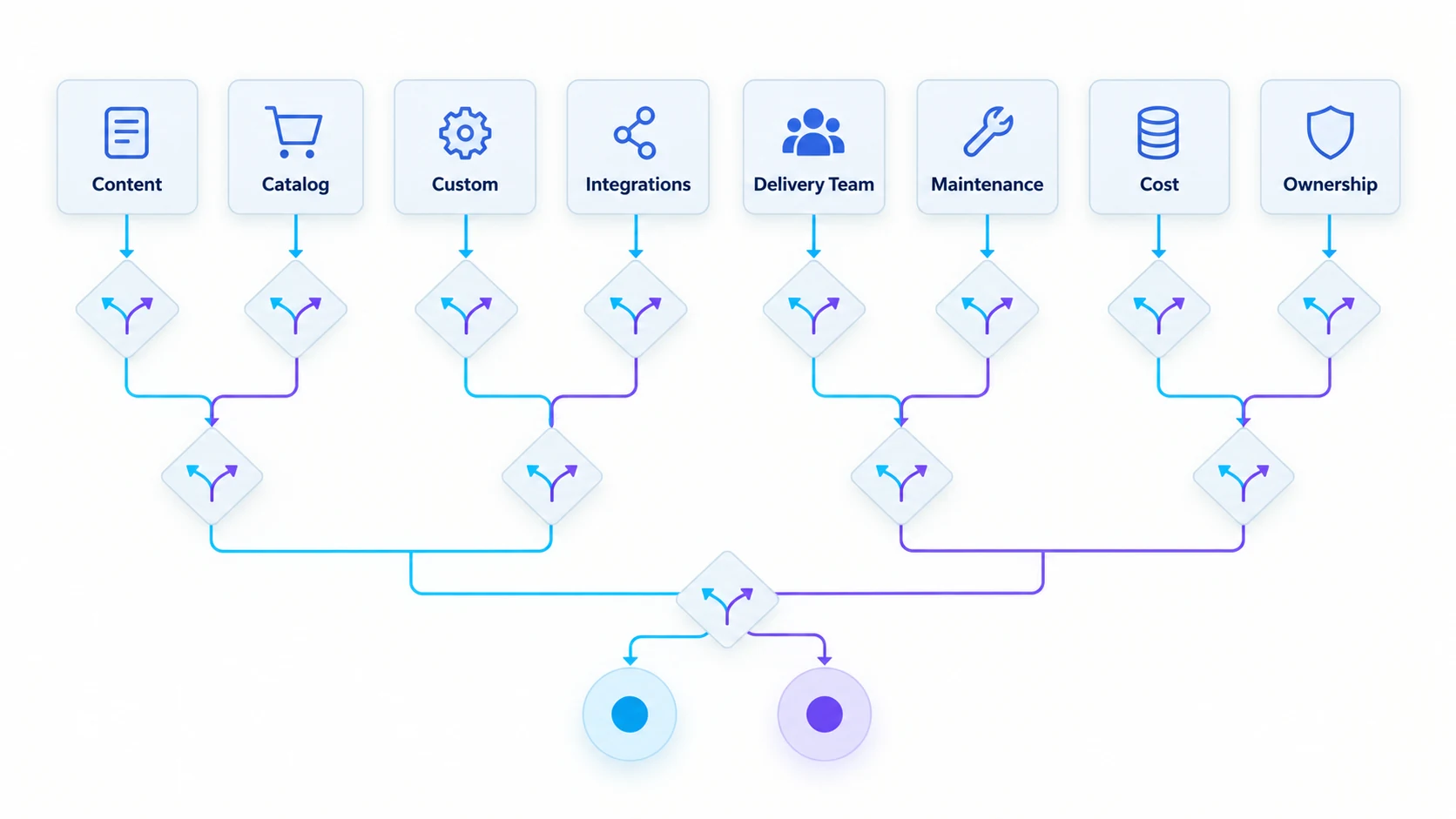
Potential use cases include education and publishing, membership purchasing, regulated content, B2B portals, donations, events, and organizations already operating Drupal successfully.
For a conventional retail store that prioritizes rapid launch and a broad ready-made app ecosystem, a hosted commerce platform may require less ownership.
Content and commerce modeling
Drupal’s entity and field systems allow teams to model products, variations, content, users, and relationships flexibly. Use that flexibility with discipline. Define identifiers, required attributes, translation behavior, revisions, ownership, and migration rules before implementation.
Drupal Commerce separates products from purchasable variations and supports extensible orders, prices, promotions, and checkout flows. Customizations should use supported APIs and extension points rather than bypassing domain rules.
Storefront choices
A traditional Drupal-rendered storefront offers cohesive content preview, routing, caching, and administration. A decoupled frontend built with React, Vue, Angular, or another framework can support specialized experiences, but adds API, preview, authentication, caching, deployment, and accessibility work.
Choose decoupling only when its customer or organizational value exceeds the additional operating cost.
Integrations and backend systems
Drupal may connect to ERP, CRM, and PIM, search, payment, tax, shipping, identity, and marketing systems. Establish a system of record for each entity. Design queues, retries, idempotency, reconciliation, and alerts for failures.
Use contributed modules when their quality and maintenance are adequate. Custom integration modules should isolate external contracts and make operational errors visible.
Performance and security
Performance depends on cache strategy, database queries, rendered components, media, search, frontend assets, and third-party scripts. Test authenticated and personalized journeys as well as anonymous pages, because caching behavior differs.
Maintain Drupal core, Commerce, contributed modules, PHP, and infrastructure on supported versions. Review permissions, protect administration, manage secrets, apply security advisories, and test updates before production.
Development process
- Validate Drupal against complete commerce and content scenarios.
- Model products, content, customers, orders, and permissions.
- Select modules and record customization boundaries.
- Design storefront, editorial, and operational workflows.
- Build integrations with observable failure handling.
- Migrate representative data early.
- Test checkout, permissions, content revisions, accessibility, and load.
- Launch with monitoring, backups, rollback, and update ownership.
Limitations and tradeoffs
Drupal Commerce may require more implementation than a packaged retail platform. Module availability, merchant expectations, upgrade paths, and the availability of experienced developers should be assessed. Excessive customization can make future updates expensive.
Its flexibility is most valuable when structured content and custom workflows are central. If those needs are minor, the business may be paying for capabilities it does not use.
Migration and long-term ownership
Drupal migrations may include products, content types, taxonomies, users, roles, files, aliases, revisions, translations, and relationships. Use repeatable scripts and validation reports rather than a one-time manual import.
Define preview, moderation, scheduled publishing, translation, and approval behavior. Budget for core, module, PHP, and infrastructure upgrades, security advisories, regression testing, and monitoring. Keep an inventory of contributed and custom modules with named owners; regular smaller upgrades are safer than delayed version jumps.
Choosing a Drupal eCommerce partner
Look for evidence across Drupal architecture, Commerce domain modeling, PHP quality, migration, integrations, security, performance, and operational support. Ask how the team evaluates contributed modules and keeps custom code upgradeable.
Flexor offers Drupal Commerce development with explicit content, transaction, and integration boundaries. Review all eCommerce development services and learn about the company.