
eCommerce Marketplace Development: Vendors, Payments, and Scaling
Vendor onboarding, catalogs, payments, commissions, trust, and marketplace architecture.
A marketplace coordinates transactions between customers and multiple sellers. Its software must manage not only shopping but also vendor onboarding, catalog quality, commissions, payments, disputes, fulfillment, trust, and regulatory responsibilities.
Marketplace development succeeds when the operating model is defined before the platform. Unclear policies become inconsistent workflows and expensive custom code.
Define the marketplace model
Clarify whether the marketplace is B2C, B2B, peer-to-peer, services, rentals, or a hybrid. Decide who sets prices, owns customer service, processes payments, holds inventory, fulfills orders, accepts returns, and carries commercial risk.
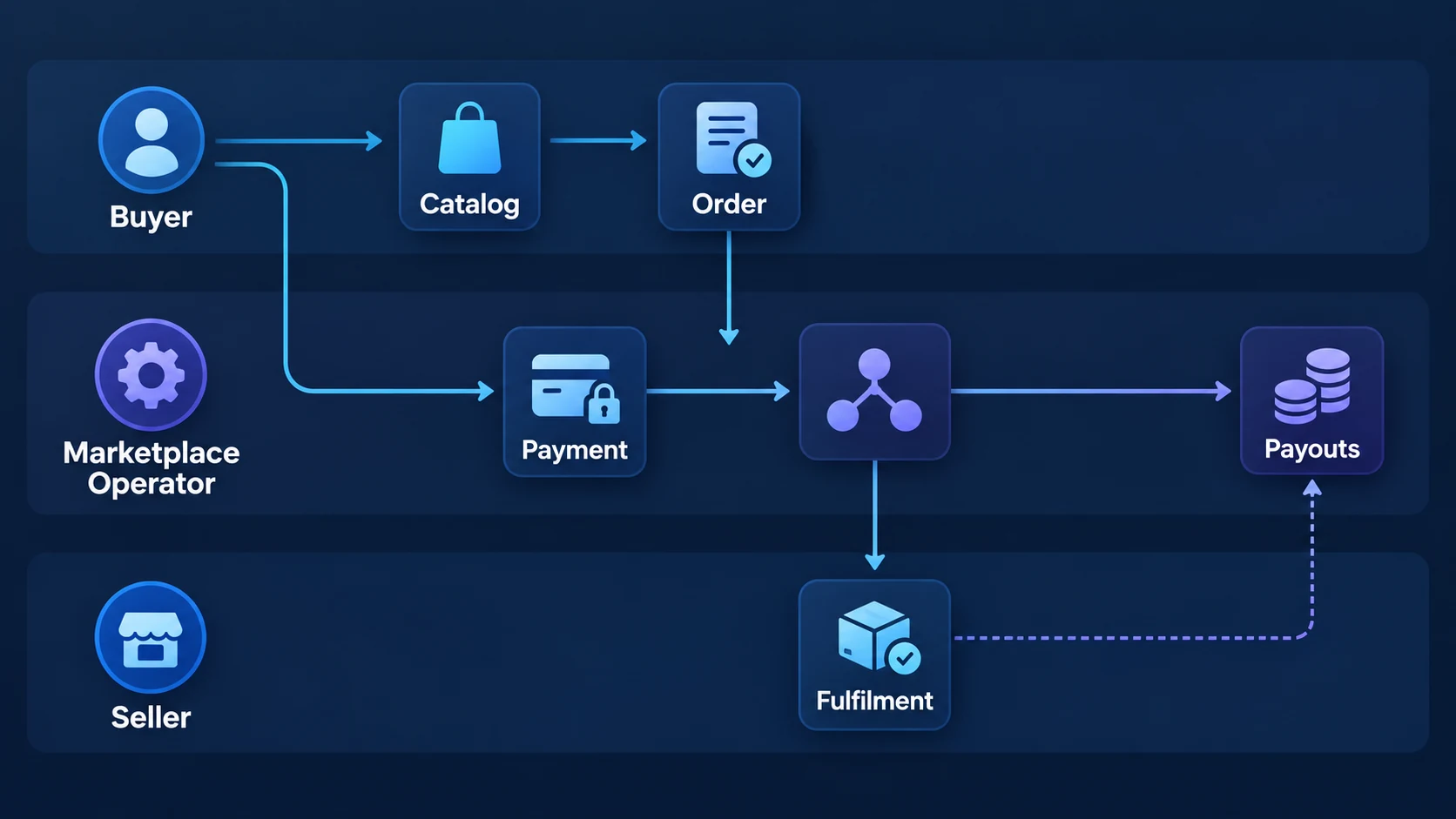
Choose the level of control: an open marketplace prioritizes supply growth; a curated marketplace reviews sellers and products; a managed marketplace may control pricing, fulfillment, or service delivery. Each model requires different administration and automation.
Vendor onboarding and governance
Onboarding may include identity, business, tax, bank, and compliance verification, and product verification. Define review states, required documents, expiry, suspension, and appeal procedures.
Vendor roles need least-privilege access. Sellers should manage relevant products, prices, inventory, orders, staff, and reports without seeing another vendor’s confidential data.
Strong self-service reduces operator workload, but exceptions require internal tools and audit trails.
Catalog architecture
Marketplaces must decide whether sellers create separate listings or contribute offers to shared products. Shared catalogs improve comparison but require product matching, attribute standards, and conflict resolution. Independent listings are simpler to submit but can create duplicates and inconsistent discovery.
Define category schemas, required attributes, media standards, restricted products, moderation, and bulk upload. Search quality depends on governed data more than on the search engine alone.
Cart, checkout, and order splitting
A customer may see one cart while the system creates several seller orders, shipments, commissions, and settlement records. Specify how promotions, tax, shipping, cancellation, return, and support work across sellers.
Keep customer communication coherent. Explain separate deliveries and policies before payment. Provide a unified account view while preserving seller-specific order states.
Payments, commissions, and payouts
Marketplace payments can involve split settlement and delayed payout, reserves, refunds, chargebacks, and platform fees. Use a payment provider designed for marketplace or connected-account models rather than building money movement from basic payment APIs.
Define commission rules, fee responsibility, payout schedules, negative balances, reconciliation, and reporting. Legal and tax obligations vary by market and should be reviewed by qualified advisers.
Trust, safety, and disputes
Trust systems may include seller verification, reviews, fraud signals, content moderation, delivery evidence, messaging controls, and dispute workflows. Reviews should be tied to genuine transactions and protected against retaliation and manipulation.
Design abuse handling as an operational system: detection, case management, evidence, decisions, communication, audit, and appeal.
Architecture for marketplace scale
Early products benefit from a simple modular architecture. Separate domain boundaries for identity, catalog, offers, carts, orders, payments, and settlements even if they begin in one deployable application.
Use events and queues for workflows that do not need immediate completion. Make consumers idempotent, keep immutable financial records, and reconcile against payment providers. Observability should connect a customer transaction to seller orders, payment events, and integration jobs.
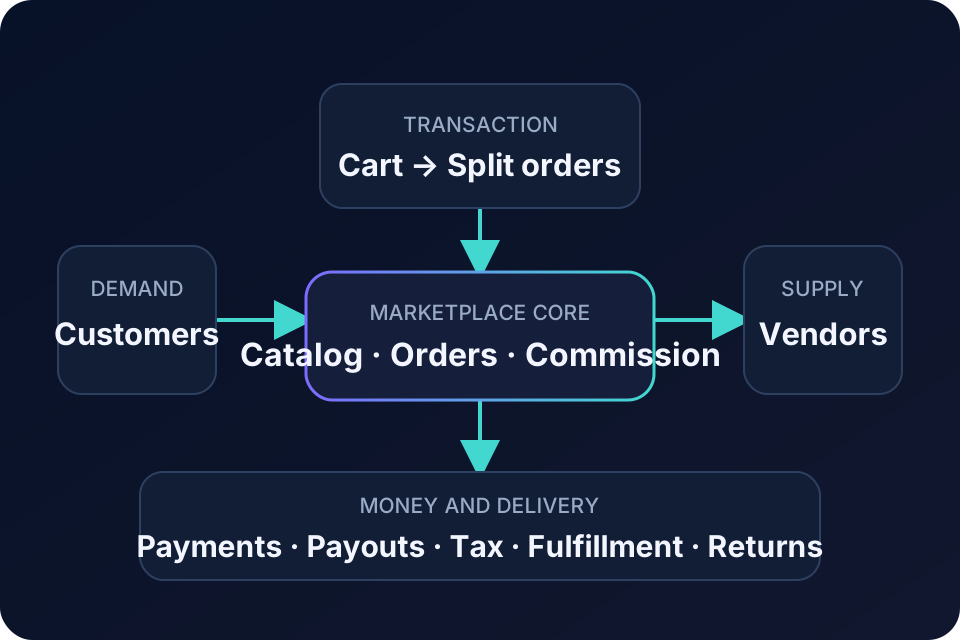
Frameworks such as Node.js, Laravel, PHP, or Angular can be valid implementation tools, but marketplace reliability depends more on domain modeling, data integrity, testing, and operations than language choice.
Build, buy, or extend a platform?
Marketplace software can accelerate vendor portals, catalog, commissions, and order splitting. A commerce platform plus marketplace extensions may fit a focused model. Custom development becomes rational when the transaction, settlement, or operational model is distinctive.
Evaluate product fit, customization boundaries, payment support, data export, multi-region requirements, total cost, and the ability to operate exceptional cases.
A practical development sequence
- Define policies, responsibilities, and unit economics.
- Map customer, vendor, operator, and finance workflows.
- Validate demand and supply with a constrained category or region.
- Design catalog, order, payment, and settlement models.
- Build the smallest complete transaction and exception paths.
- Integrate verification, payments, tax, shipping, and notifications.
- Test permissions, reconciliation, refunds, disputes, and load.
- Launch gradually with operational staffing and monitoring.
Flexor offers eCommerce marketplace development for custom transaction and operating models. Review all eCommerce development services and learn about the team.
Marketplace metrics that reveal product health
Gross merchandise value can hide an unhealthy marketplace. Track active sellers, listing quality, time to first sale, search-to-purchase conversion, fulfillment reliability, cancellations, refunds, disputes, payout accuracy, support demand, and contribution margin.
Measure liquidity within meaningful categories and regions. A large supply count does not help when customers cannot find relevant available offers. Define service levels for verification, moderation, disputes, and payouts; these are product capabilities even when people perform part of the work manually.
Marketplace operating models
| Model | Inventory ownership | Fulfillment | Payment flow | Primary challenge |
|---|---|---|---|---|
| Operator retail | Operator | Operator | Single merchant | Merchandising and supply |
| Curated marketplace | Seller or mixed | Seller or mixed | Split or settlement | Governance and service levels |
| Open marketplace | Seller | Mostly seller | Multi-party | Trust, moderation, compliance |
| B2B network | Supplier | Contract-specific | Invoice or terms | Accounts, contracts, approvals |