
Shopify Store Development: Process, Capabilities, and Limitations
Shopify strengths, customization limits, and the stages of launching a reliable store.
Shopify can shorten the path to a reliable online store by providing hosted commerce infrastructure, checkout, administration, payments, and a broad application ecosystem. The platform still requires careful product modeling, UX, integrations, performance work, and operational planning.
Effective Shopify eCommerce development uses native capabilities where they fit and adds custom code only where it creates measurable value.
When Shopify is a strong choice
Shopify fits many direct-to-consumer, retail, and growing international stores. It is particularly attractive when the organization values managed infrastructure, frequent platform improvements, a mature ecosystem, and a fast operational learning curve.
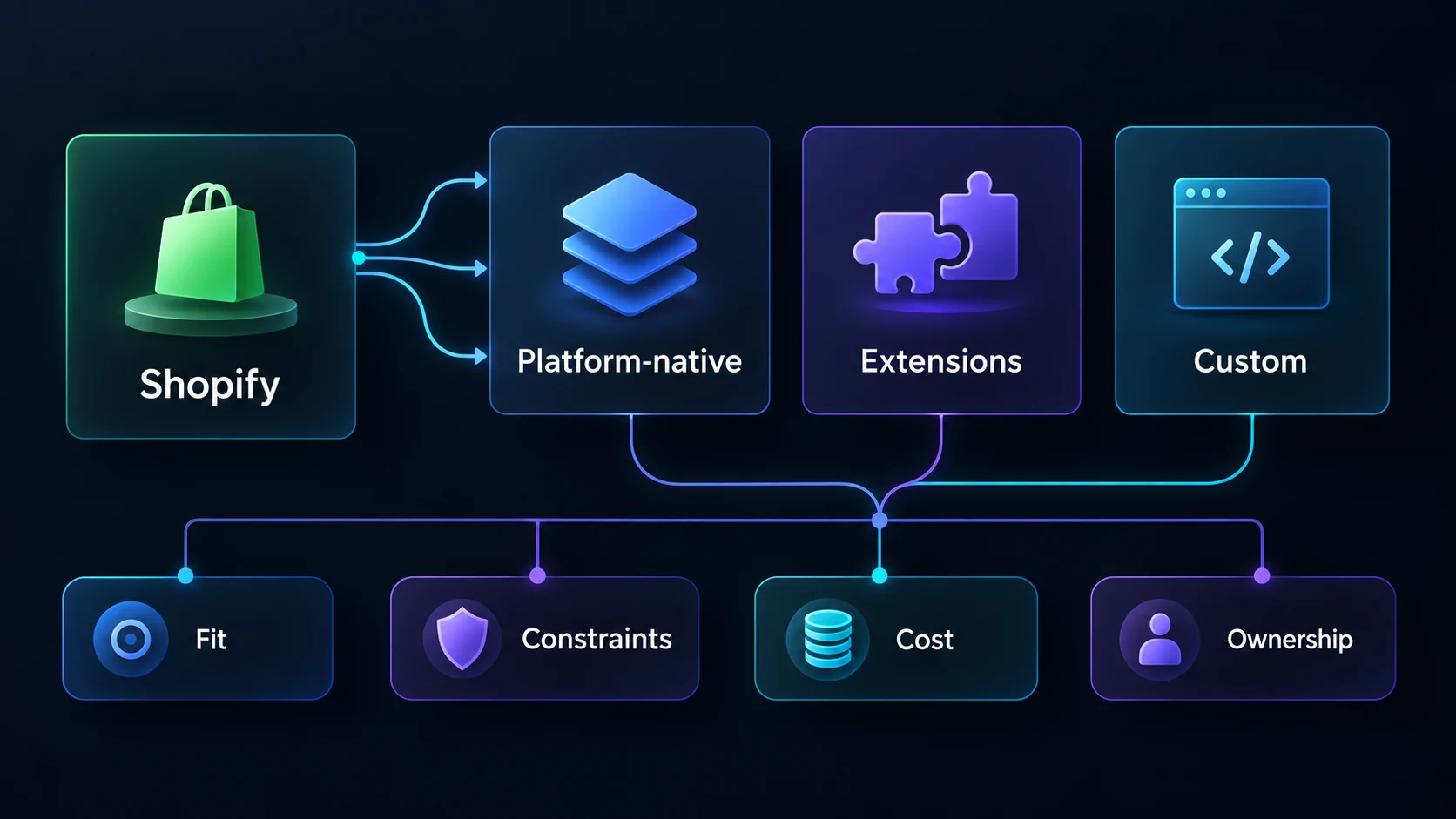
Evaluate fit against catalog structure, markets, pricing, promotions, checkout rules, content, B2B requirements, subscriptions, integrations, and expected order volume. Shopify Plus can expand enterprise and B2B options, but commercial edition alone does not solve every workflow.
Theme development versus custom storefronts
A well-engineered Shopify theme is often the simplest and most maintainable storefront. It can deliver distinctive UX without separating frontend hosting, preview, content, and commerce APIs.
Headless development can support unusual experiences, multiple touchpoints, or advanced frontend ownership. It also adds infrastructure, caching, API limits, deployment, preview, monitoring, and integration complexity. Choose it only when those costs are justified.
Shopify template development should preserve compatibility with the theme editor, sections, product data, localization, and merchant workflows. A visually flexible theme that content teams cannot operate is not successful.
Apps and custom functionality
Applications are useful for established capabilities such as reviews, subscriptions, search, loyalty, and feeds. Each app should be assessed for data access, storefront scripts, recurring cost, support, export options, and overlap with other tools.
Too many apps can create inconsistent UX, slow pages, duplicated data, and fragile dependencies. Before installing one, ask whether the requirement is essential, whether Shopify supports it natively, and whether a focused custom application would provide a cleaner result.
Integrations and data ownership
Shopify frequently connects to ERP, PIM, CRM, and OMS, warehouses, marketplaces, and analytics. Define which system owns products, inventory, prices, customers, and orders. Use webhooks and APIs with idempotency, retries, reconciliation, and monitoring. For this work, review commerce systems integration separately from theme development.
Do not assume every synchronization can be immediate. Make latency and availability promises explicit, and design customer-facing behavior for temporary downstream failures.
Performance and technical SEO
Start with a lean theme, optimized media, limited scripts, and deliberate application choices. Measure product, collection, content, cart, and checkout-adjacent experiences on real devices. Core Web Vitals are affected by layout stability, JavaScript, fonts, images, apps, and tag managers.
Technical SEO work should cover crawlable navigation, canonical behavior, faceted URLs, redirects, metadata, structured data, international targeting, and migration. Platform defaults are a foundation, not a complete SEO strategy.
A practical Shopify development process
- Define commercial goals and operational workflows.
- Validate Shopify and plan edition, markets, apps, and integrations.
- Model products, variants, collections, metafields, and content.
- Design responsive customer journeys and theme components.
- Build integrations and custom functions with observable failure handling.
- Migrate and validate products, customers, content, and redirects.
- Test payments, taxes, shipping, discounts, accessibility, and performance.
- Rehearse launch and establish monitoring and maintenance.
Shopify limitations to evaluate
Potential constraints include highly specialized checkout behavior, unusual pricing, complex product models, strict data-residency needs, or workflows that require deep transaction control. API limits and platform release policies also shape architecture.
Constraints are not defects; they are boundaries. A good Shopify development company identifies them early and recommends alternatives when workarounds would become expensive or brittle.
Migration, launch, and ownership
Map products, variants, customers, gift cards, content, orders, and redirects before migration. Rehearse launch with production-like data and confirm payments, tax, shipping, notifications, consent, analytics, support access, and rollback decisions. After release, monitor payment failures, search terms, integration queues, and storefront performance—not only revenue.
Assign owners for theme code, applications, catalog configuration, integrations, analytics, and platform releases. Review apps and scripts periodically; small dependencies accumulate and eventually make teams afraid to change the store.
Choosing a Shopify partner
Ask how the team controls app sprawl, preserves merchant usability, handles upgrades, tests performance, and designs integrations. Review experience with similar operational complexity rather than only similar visual design.
Flexor offers Shopify and Shopify Plus development within its commerce platform practice. Review all eCommerce development services and learn about the company.
Ready-made theme, custom theme, or headless
| Option | Ready-made theme | Custom theme | Headless storefront |
|---|---|---|---|
| Time to market | Fastest | Moderate | Longest |
| UX control | Limited by theme | High within Shopify | Highest |
| Technical ownership | Low | Moderate | High |
| Best fit | Standard launch | Distinctive branded store | Complex multi-channel experience |
Frequently asked questions
Is Shopify suitable for enterprise eCommerce?
It can be. Validate complex workflows, integrations, governance, international requirements, and total platform economics rather than relying on company size alone.
Do I need a custom Shopify theme?
Not always. A quality existing theme may suit a standard launch. Custom theme work is valuable when brand, content, merchandising, accessibility, or conversion requirements are materially different.
Can Shopify integrate with an ERP?
Yes. The integration must define data ownership, mapping, timing, retries, reconciliation, and support responsibilities.
When should Shopify not be used?
Consider alternatives when essential transaction or operational rules require extensive workarounds, when ownership constraints conflict with the platform, or when total economics are unfavorable.
When is a custom Shopify theme justified?
Use one when brand, merchandising, accessibility, or performance requirements cannot be met cleanly by adapting a maintained theme.
When is headless Shopify excessive?
It is excessive when native storefront capabilities meet the customer journey and the team lacks a clear need and operating model for a separate frontend.