
BigCommerce Development: When the Platform Fits Your Business
Capabilities, integrations, storefront options, and ownership trade-offs.
BigCommerce is a hosted commerce platform for businesses that want managed core infrastructure with substantial catalog, API, B2B, and multi-storefront capabilities. Its value is not that it eliminates development; it lets teams concentrate more effort on customer experience, integration, and operations.
Platform fit should be tested against real workflows, commercial terms, and ownership requirements.
Where BigCommerce fits well
BigCommerce can support growing B2C and B2B operations, multiple brands or regions, and integration-heavy commerce. It is worth evaluating when the business needs:
- managed hosting and platform security;
- flexible product catalogs and promotions;
- several storefronts connected to shared commerce administration;
- established B2B account and purchasing capabilities;
- APIs for custom applications or headless storefronts;
- connections to ERP, PIM, OMS, CRM, search, and marketplaces.
Edition, commercial terms, and feature availability should be verified for the intended scope. A checklist is not enough; prototype the workflows that carry the most operational or revenue risk.
Theme-based and headless storefronts
A theme-based storefront offers the simplest operating model and can still support a distinctive, fast interface. Custom theme work should retain merchant control, responsive behavior, accessibility, and upgrade compatibility.
BigCommerce also supports headless architectures. These can serve multiple channels or advanced frontend needs, but add hosting, API orchestration, preview, caching, deployment, and monitoring. Select headless for a specific product or organizational advantage, not as a default upgrade.
Integrations and data ownership
Define which system owns products, prices, inventory, customers, orders, and fulfillment. For each flow, specify direction, timing, validation, retries, reconciliation, and support ownership.
Brightpearl, ERP, PIM, and OMS integrations must account for partial failures and rate limits. Use queues and idempotent processing where synchronous dependencies would make the customer journey fragile. Give operators tools to identify and replay failed work safely.
Customization boundaries
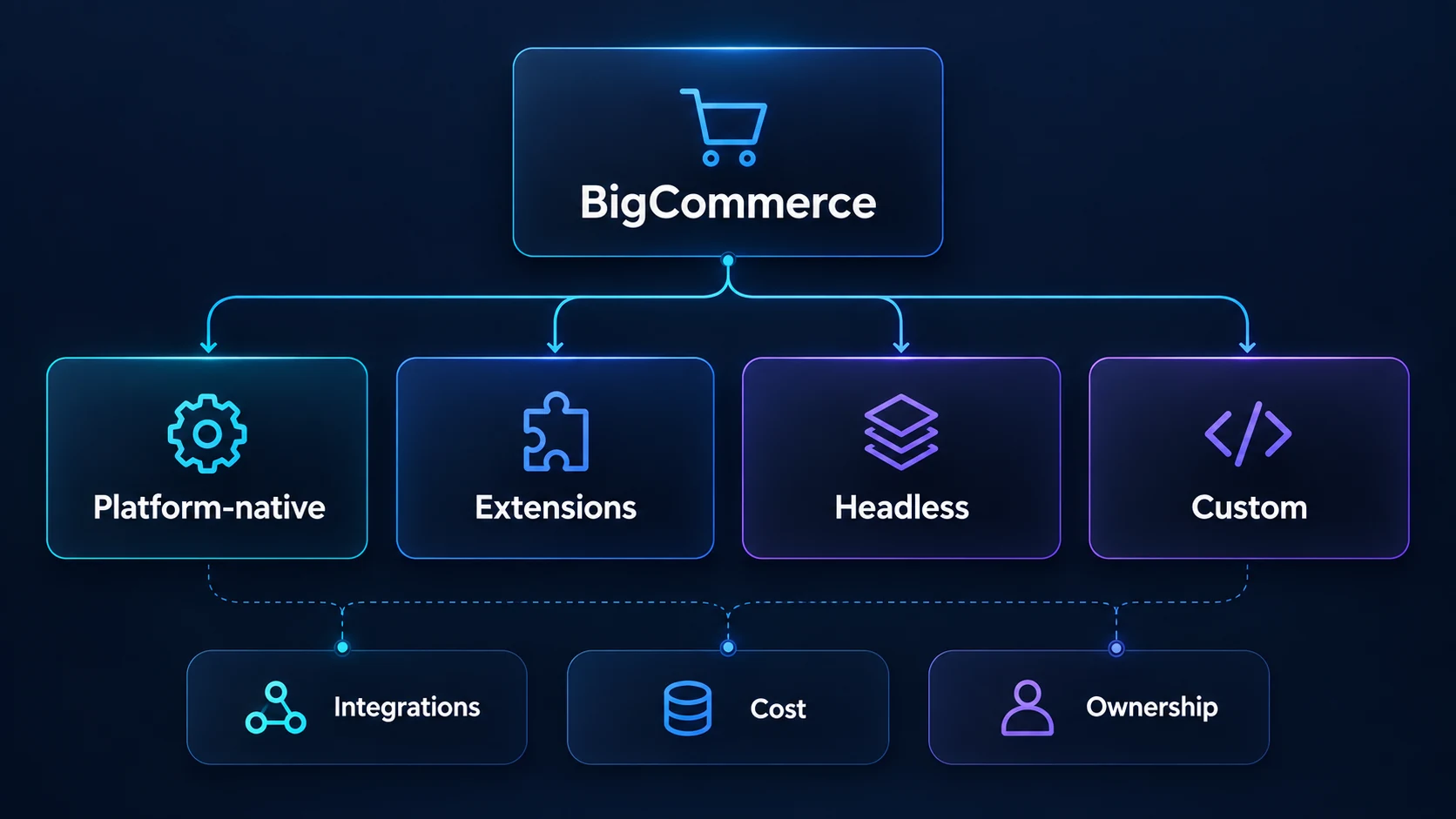
Use native capabilities where they fit. Add applications or custom services when they solve a defined gap. Evaluate every extension for data access, recurring cost, storefront scripts, support, and exit options.
If an essential pricing, checkout, product, or fulfillment rule requires layered workarounds, compare another platform or custom service before committing. Honest architecture recognizes platform boundaries early.
Performance, SEO, and quality
Managed infrastructure does not guarantee a fast storefront. Theme code, images, fonts, applications, analytics, and third-party scripts strongly affect Core Web Vitals. Set page-level performance budgets and test real devices.
Technical SEO should cover navigation, faceted URLs, canonicals, redirects, structured data, international pages, and migration. Quality assurance should test taxes, shipping, payments, discounts, account permissions, integrations, accessibility, and error recovery.
Delivery process
- Document customer and operational workflows.
- Validate platform edition, constraints, and total cost.
- Model catalog, content, storefronts, and data ownership.
- Design UX and prototype uncertain journeys.
- Build focused customizations and observable integrations.
- Migrate and validate data and redirects.
- Test complete transactions and failure states.
- Launch with monitoring, rollback, and support procedures.
Migration and multi-storefront governance
Inventory existing URLs, products, customers, content, promotions, and integrations before migration. Validate edge cases early and rehearse production imports. Redirects, canonicals, structured data, and analytics continuity should be tested alongside orders. See the controlled replatforming scope when the work replaces an existing commerce system.
For multiple storefronts, define which products, prices, inventory, content, accounts, and integrations are shared by brand or region. Compare licensing with applications, integrations, data work, support, and internal administration. Managed hosting reduces infrastructure work; it does not remove product ownership.
Choosing BigCommerce developers
Ask a BigCommerce agency how it limits application sprawl, handles integration failures, preserves merchant usability, tests performance, and plans post-launch ownership. Relevant operational experience matters more than a long list of visually similar storefronts.
Flexor provides BigCommerce development, platform assessment, and integration delivery. Review all eCommerce development services and learn about the company.