
How to Choose an eCommerce Development Company
Criteria for evaluating a team, its process, expertise, and technical decisions.
Choosing an eCommerce development company is not mainly a portfolio comparison. The decision is whether a team can understand your commercial model, turn it into reliable software, and support the system after revenue depends on it.
The strongest vendor is not necessarily the largest or cheapest. It is the one that can explain the architecture, delivery process, risks, and tradeoffs in terms your business and technical stakeholders can verify.
Start with the problem, not the platform
Before comparing agencies, define the operating model. Record customer types, sales regions, catalog complexity, merchandising needs, payment and fulfillment rules, integrations, order volume, migration requirements, and constraints imposed by existing systems.
Do not begin with “we need Shopify” or “we need a custom platform” unless that decision has already been validated. A capable eCommerce development agency should test the platform assumption against requirements rather than simply sell its preferred technology.
What services should the company provide?
The required mix depends on the project, but a full delivery partner should be able to cover or coordinate:
- product discovery and requirements definition;
- solution and data architecture;
- UX research, information architecture, and interface design;
- frontend and backend engineering;
- payment, ERP and CRM, PIM and OMS, and shipping integrations;
- migration and SEO-preserving launch planning;
- automated and manual quality assurance;
- security, accessibility, and performance work;
- monitoring, maintenance, and post-launch development.
Ask who owns each workstream. A proposal may look complete while relying on unassigned client work for content, data cleanup, integration documentation, or acceptance testing.
Evaluate relevant experience
Industry labels alone are weak evidence. Look for experience with problems similar to yours: customer-specific pricing, multi-warehouse inventory, subscriptions, product configuration, international catalogs, marketplace settlements, high traffic, or legacy migration.
For each case study, ask what the company actually delivered, which constraints mattered, what changed during implementation, and how success was measured. Screenshots show visual quality; they do not prove architecture, reliability, or operational impact.
Test technical judgment
A good technical conversation should make the decision clearer, not more mysterious. Ask the team to explain:
- why the proposed platform fits the requirements;
- which functions should remain native and which require customization;
- how products, customers, inventory, and orders move between systems;
- how failures, retries, and data conflicts are handled;
- how performance will be measured under realistic load;
- how deployments, rollbacks, monitoring, and security updates work;
- what would make the team change its recommendation.
Specific answers demonstrate judgment. Repeated claims that a technology is “scalable” without describing limits, state, traffic, or operational ownership do not.
Review the delivery process
An effective process creates frequent evidence. Discovery should produce decisions and prioritized requirements. Design should test critical journeys. Engineering should deliver working increments. Quality assurance should begin before the final week.
Ask to see the expected artifacts: architecture diagrams, user stories, acceptance criteria, prototypes, test plans, release checklists, and operational documentation. Confirm who can approve scope, how changes are estimated, and how blocked decisions affect the schedule.
Transparent reporting matters more than the label “Agile.” You should know what is complete, what is uncertain, what changed, and which decisions are needed from your team.
Compare proposals on the same basis
Normalize proposals before comparing price. Separate discovery, design, implementation, migration, integrations, testing, launch, licenses, and support. Identify whether estimates are fixed, capped, or time-and-materials and what assumptions make them valid.
Look closely at exclusions. Content entry, data cleansing, accessibility, analytics, redirect mapping, load testing, training, and warranty support may be omitted even when the launch requires them.
A lower estimate can be legitimate because the approach is simpler. It can also mean that risk has been moved into change requests or client responsibilities.
Check communication and team continuity
Meet the people expected to lead the work. Clarify whether senior specialists involved in sales will remain involved during delivery. Understand time-zone overlap, communication channels, response expectations, and escalation paths.
For complex commerce, continuity is valuable. Frequent team changes increase onboarding cost and weaken context around business rules and architectural decisions.
Verify ownership and post-launch support
Contracts should define ownership of source code, designs, accounts, domains, cloud infrastructure, documentation, and third-party licenses. Your business should retain access to production systems and essential vendor accounts.
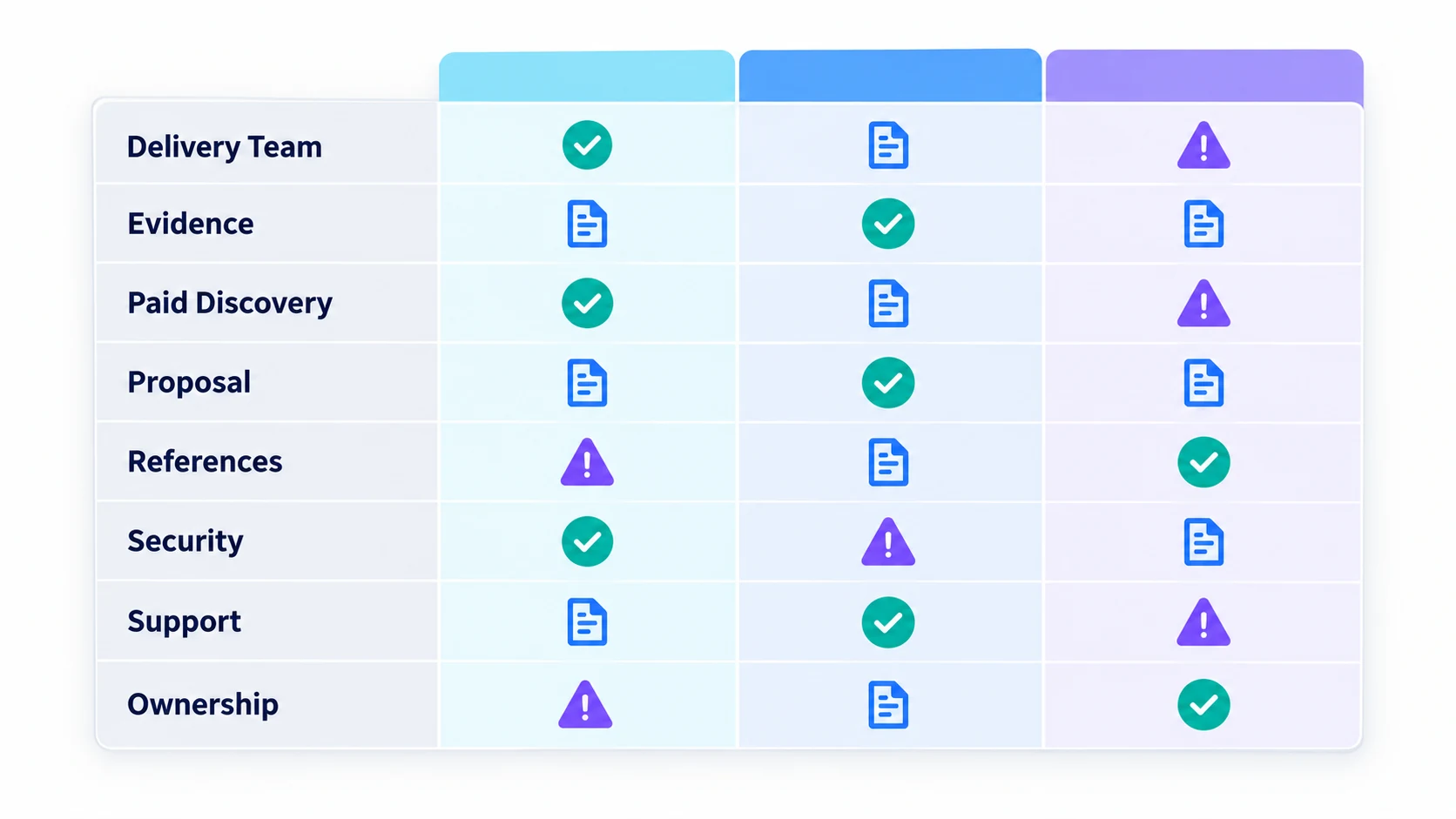
Also confirm the post-launch model: warranty period, incident severity levels, response times, monitoring, maintenance, release cadence, and handover options. A store is an evolving product, so the end of the initial project should not be an operational cliff.
Warning signs
Be cautious when a vendor:
- recommends a platform before understanding requirements;
- promises rankings, conversion gains, or launch dates without evidence;
- cannot explain exclusions or dependencies;
- treats integrations as simple API calls without discussing data ownership;
- postpones testing, security, or performance until the end;
- avoids introducing the delivery team;
- offers no credible maintenance or handover plan.
Make the decision with evidence
Shortlist companies whose expertise matches the difficult parts of your project. Run structured interviews, compare the same scope, check references, and consider a paid discovery phase when architecture or integration risk is high.
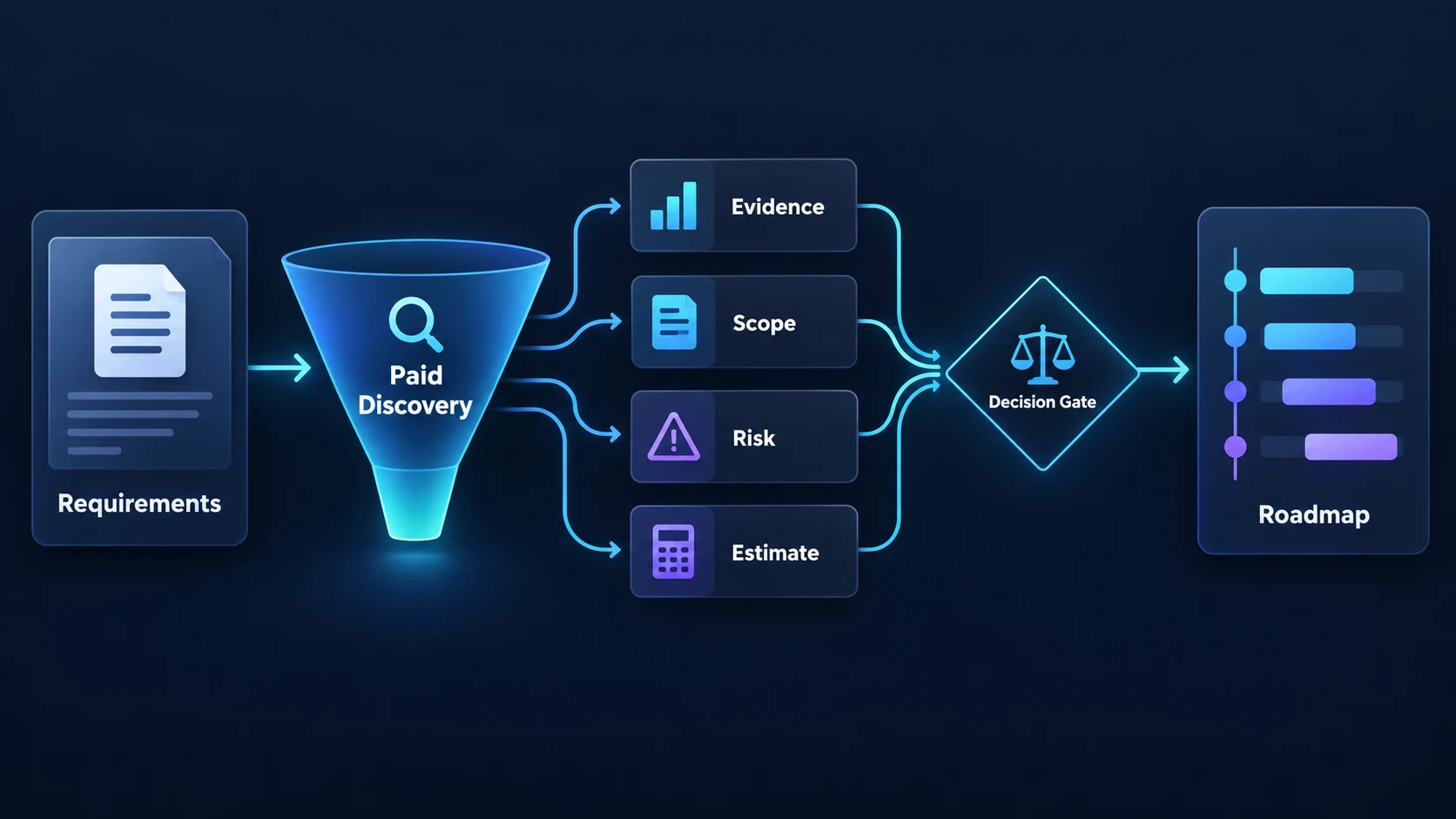
Review Flexor as an eCommerce development company for complex commerce, then compare its eCommerce development services and the company’s background and engineering focus as part of your evaluation.
Ways to organize eCommerce delivery
| Option | Freelancer | Small generalist team | Specialized eCommerce company |
|---|---|---|---|
| Best for | Bounded tasks | Straightforward builds | Complex connected commerce |
| Coverage | Individual expertise | Several disciplines | Product, UX, engineering, QA, operations |
| Continuity risk | High | Moderate | Lower with documented ownership |
| Governance | Lightweight | Team-dependent | Defined delivery and escalation |
Frequently asked questions
What should I ask an eCommerce development company first?
Ask how it would validate your requirements and choose an architecture. The answer should reveal whether the team begins with business workflows and constraints or immediately promotes a preferred platform.
Should I choose a specialist or a full-service agency?
Choose according to the project’s coordination needs. A specialist can be ideal for a narrow platform task. A full-service partner is often better when discovery, UX, backend systems, migration, QA, and ongoing ownership must work together.
Is a fixed-price proposal safer?
Only when the scope and assumptions are sufficiently clear. Fixed pricing does not remove uncertainty; it determines who carries it and how changes are handled.
How many companies should I compare?
Three well-qualified proposals are usually more informative than a large list of superficial quotes. Prequalify vendors before asking them to invest in a detailed response.
What evidence should an agency provide?
Look for relevant technical reasoning, clear responsibilities, realistic assumptions, quality controls, communication practices, and examples that can be verified without exaggerated claims.
How should proposals be compared?
Normalize scope, integrations, migration, testing, environments, support, exclusions, rates, change process, and ownership so headline prices are genuinely comparable.