
How Much Does eCommerce Website Development Cost?
What drives development cost and how to plan a realistic budget.
An eCommerce estimate is useful only when it explains what is being built. A small catalog on a hosted platform, a B2B portal with account-specific pricing, and a marketplace with multiple vendors may all be called “eCommerce websites,” yet they require different architecture, integrations, testing, and operational support.
The practical answer is that eCommerce website development cost depends on scope, technical risk, and the amount of business logic the store must support. Instead of relying on a generic price range, define the capabilities that affect revenue and operations, then ask vendors to estimate the same documented scope.
What determines eCommerce website development cost?
The largest cost drivers are not the number of pages. They are the number of systems, workflows, customer types, and exceptions the solution must handle.
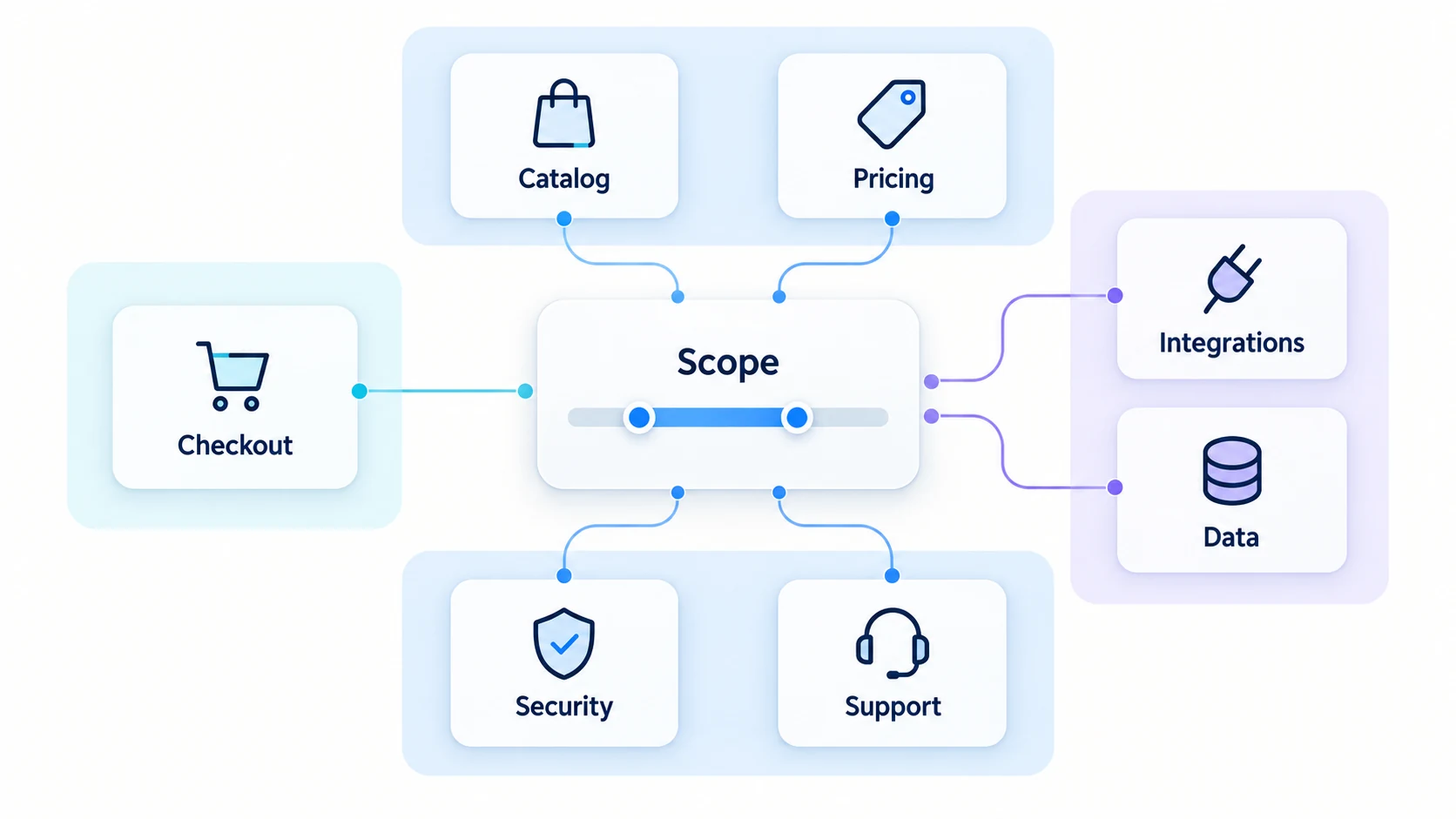
Platform and architecture
A standard Shopify or WooCommerce implementation can reduce initial engineering because catalog, checkout, and administration features already exist. Magento, BigCommerce, or a composable architecture may be more appropriate when the business needs complex catalogs, international operations, B2B rules, or deeper control.
Custom eCommerce development costs more initially because the team must design and maintain more of the system. It can still be the economical choice when platform constraints would otherwise require fragile workarounds, excessive apps, or repeated replatforming.
UX and visual design
Adapting a proven theme is different from designing a customer journey around research, merchandising, and usability testing. The latter includes information architecture, responsive behavior, product discovery, product-detail templates, cart states, checkout, account areas, and accessibility.
Design should be budgeted according to commercial risk. A high-traffic store can lose more from a confusing checkout than it saves by shortening the design phase.
Integrations and data
Payment gateways are only one part of the integration scope. Projects commonly connect ERP, CRM, PIM, and OMS, warehouse, tax, shipping, analytics, search, and marketing systems. Each connection introduces data mapping, authentication, failure handling, synchronization rules, and testing.
An integration estimate should specify the source of truth for products, prices, inventory, customers, and orders. Ambiguity here often becomes expensive rework.
Business rules
Tiered pricing, regional catalogs, approval workflows, subscriptions, product configuration, marketplace commissions, split shipments, returns, and customer-specific terms all increase complexity. These requirements should be expressed as testable scenarios rather than broad labels such as “B2B support.”
Migration and content
Moving products, customers, orders, redirects, reviews, and media can be a project in itself. Data quality matters: duplicates, missing attributes, inconsistent variants, and legacy URLs require cleanup and validation. SEO migration also needs redirect mapping, metadata preservation, canonical rules, and post-launch monitoring.
Typical budget levels
Exact prices vary by market and team, but projects usually fall into three planning categories.
| Project type | Typical scope | Budget behavior |
|---|---|---|
| Platform-based store | Standard catalog, configured theme, basic payments and shipping | Lower initial cost; subscriptions and apps add recurring cost |
| Customized commerce site | Bespoke UX, custom modules, several integrations, migration | Higher discovery and engineering effort; better fit for differentiated workflows |
| Complex commerce platform | B2B, marketplace, multi-region, composable services, extensive integrations | Significant architecture, QA, security, and operational investment |
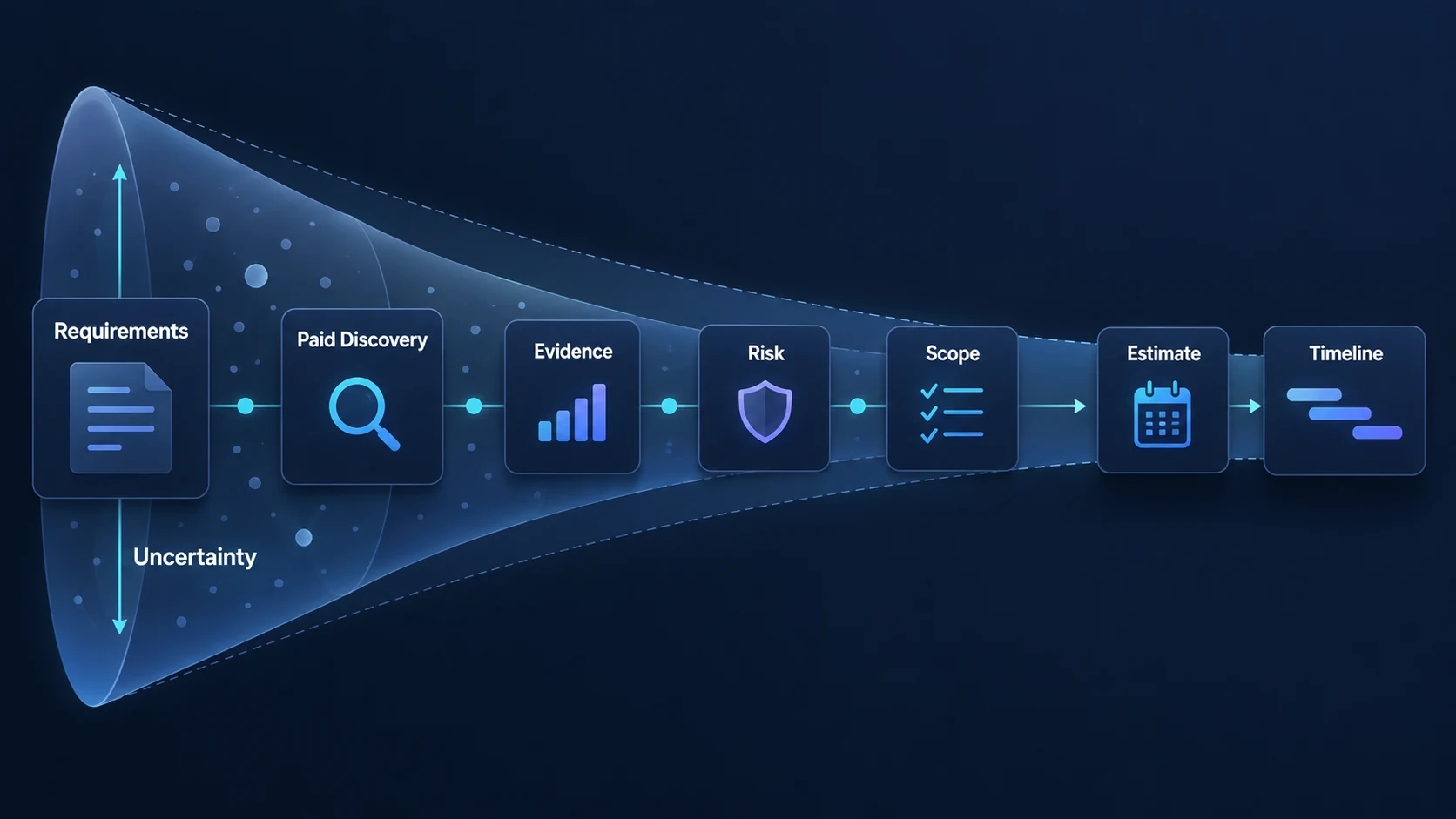
Treat any price quoted before discovery as provisional. A credible estimate states assumptions, exclusions, dependencies, and an uncertainty range.
Costs that are often omitted
The development quote is not the total cost of ownership. Plan for:
- platform, hosting, search, email, and third-party application fees;
- payment processing and fraud-prevention fees;
- content production and product-data preparation;
- security updates, monitoring, backups, and incident response;
- accessibility, performance, browser, and device testing;
- analytics implementation and consent management;
- ongoing conversion improvements and feature development.
These costs do not mean the project is poorly scoped. They are part of operating a revenue system rather than publishing a static website.
How to request a useful estimate
Start with business outcomes, but translate them into observable requirements. Document sales regions, customer types, catalog size, expected order volume, integrations, migration sources, payment methods, fulfillment rules, languages, currencies, and launch constraints.
Ask each eCommerce development company to provide:
- a recommended approach and the alternatives considered;
- assumptions and items excluded from the estimate;
- effort by phase or workstream;
- third-party and recurring costs;
- change-control and acceptance procedures;
- post-launch support options;
- the main technical and schedule risks.
This makes proposals comparable and reveals whether the vendor understands the operational system behind the storefront.
How to control cost without weakening the product
Prioritize a coherent first release. Remove features that do not support launch objectives, but do not remove foundations such as data ownership, security, performance, analytics, and test coverage.
A short discovery phase can reduce total cost by validating architecture and integration assumptions before full implementation. Prototypes are useful for uncertain customer journeys; technical spikes are useful for uncertain APIs or performance constraints.
Reuse platform capabilities where they fit. Build custom functionality where it creates differentiation or supports essential operations. That boundary is more valuable than a blanket “custom versus template” decision.
Choose a budget around measurable scope
The right budget is the one that supports required customer journeys, reliable operations, and a maintainable release plan. Flexor’s eCommerce store development scope covers discovery, architecture, design, integrations, migration, launch, and ongoing improvement. You can also review all eCommerce development services and learn more about the team before discussing an estimate.
What drives eCommerce development cost
| Cost layer | Typical driver | Evidence needed |
|---|---|---|
| Platform | Edition, hosting, extensions | Workflow-to-feature fit |
| Custom engineering | Unique rules and interfaces | Prioritized requirements |
| Integrations | Systems, direction, frequency | Contracts and sample payloads |
| Migration | Volume and data quality | Profiling and mapping |
| Operations | SLA, monitoring, support | Ownership and incident model |
Frequently asked questions
How long does eCommerce website development take?
A focused platform implementation may take weeks, while a customized or integration-heavy project often takes several months. Timing depends on decision speed, data readiness, integration access, content, testing, and the number of launch dependencies.
Is custom eCommerce development always more expensive?
It usually costs more initially, but not always over the product’s lifetime. Custom development may reduce app fees, manual work, platform workarounds, and future replatforming when requirements are genuinely specialized.
Why do agency estimates differ so much?
Agencies may be pricing different assumptions, quality levels, team structures, or scopes. Compare deliverables, exclusions, testing, migration, integrations, support, and recurring costs—not only the total.
Should maintenance be included in the budget?
Yes. Commerce systems require security updates, monitoring, dependency maintenance, platform upgrades, performance work, and incremental improvements after launch.
Why do early estimates vary widely?
Teams make different assumptions about scope, data, integrations, quality, environments, and support. A range is credible only when those assumptions are explicit.
How can cost be reduced safely?
Reduce or phase low-value scope, reuse mature capabilities, clean data early, clarify decisions, and protect testing and observability rather than removing them.