Magento / Adobe Commerce Development: Capabilities and Agency Selection
When Magento fits the business, what the platform enables, and how to evaluate a technical partner.
Magento—now offered commercially as Adobe Commerce—fits organizations that need substantial control over catalogs, promotions, customer groups, checkout, and integrations. That flexibility is valuable only when the business can support the engineering and operational discipline the platform requires.
Magento eCommerce development should begin with a fit assessment, not a feature demonstration. The question is whether its capabilities solve requirements more cleanly than a hosted platform or a custom commerce architecture.
Where Magento is a strong fit
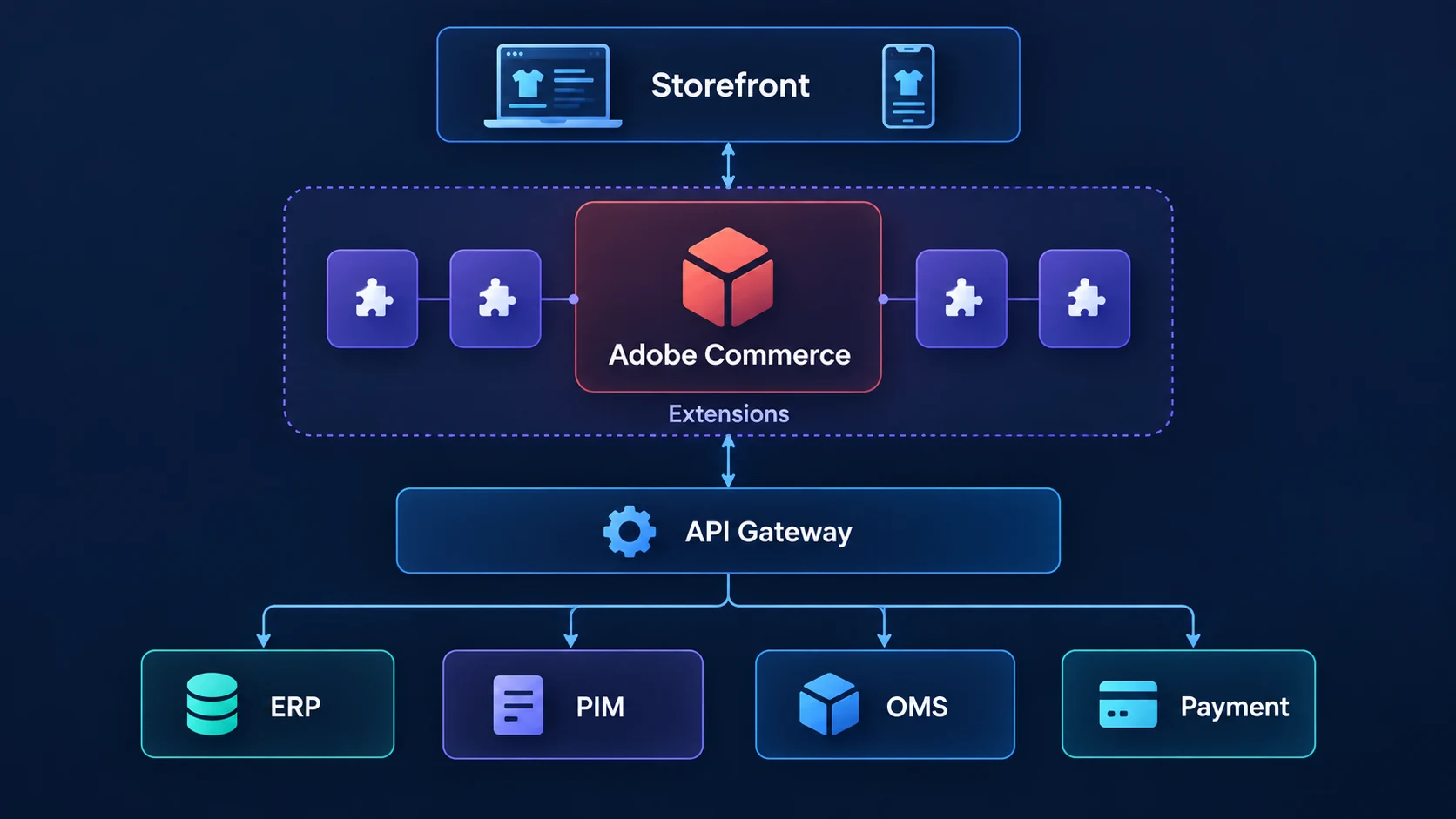
Magento is commonly considered for large or complex catalogs, multiple stores and brands, international operations, B2B purchasing, advanced promotions, and integration-heavy environments. Its extension model and source-level flexibility give teams control that more constrained SaaS platforms may not provide.
It can be particularly useful when a business needs:
- several websites, catalogs, languages, or currencies under one administration model;
- customer-group pricing and account-specific commercial rules;
- configurable, bundled, grouped, or otherwise complex products;
- custom checkout and order workflows;
- deep ERP, PIM, CRM, and OMS, search, or marketplace integrations;
- an established B2B feature set;
- ownership of hosting and deployment architecture.
Magento is not automatically the right choice for every ambitious store. A conventional catalog with a small team may gain more from the lower operational burden of a hosted platform.
Open Source and Adobe Commerce
Magento Open Source provides core commerce capabilities and can support substantial custom development. Adobe Commerce adds licensed enterprise features and managed-cloud options, including capabilities relevant to B2B, merchandising, content, and operations.
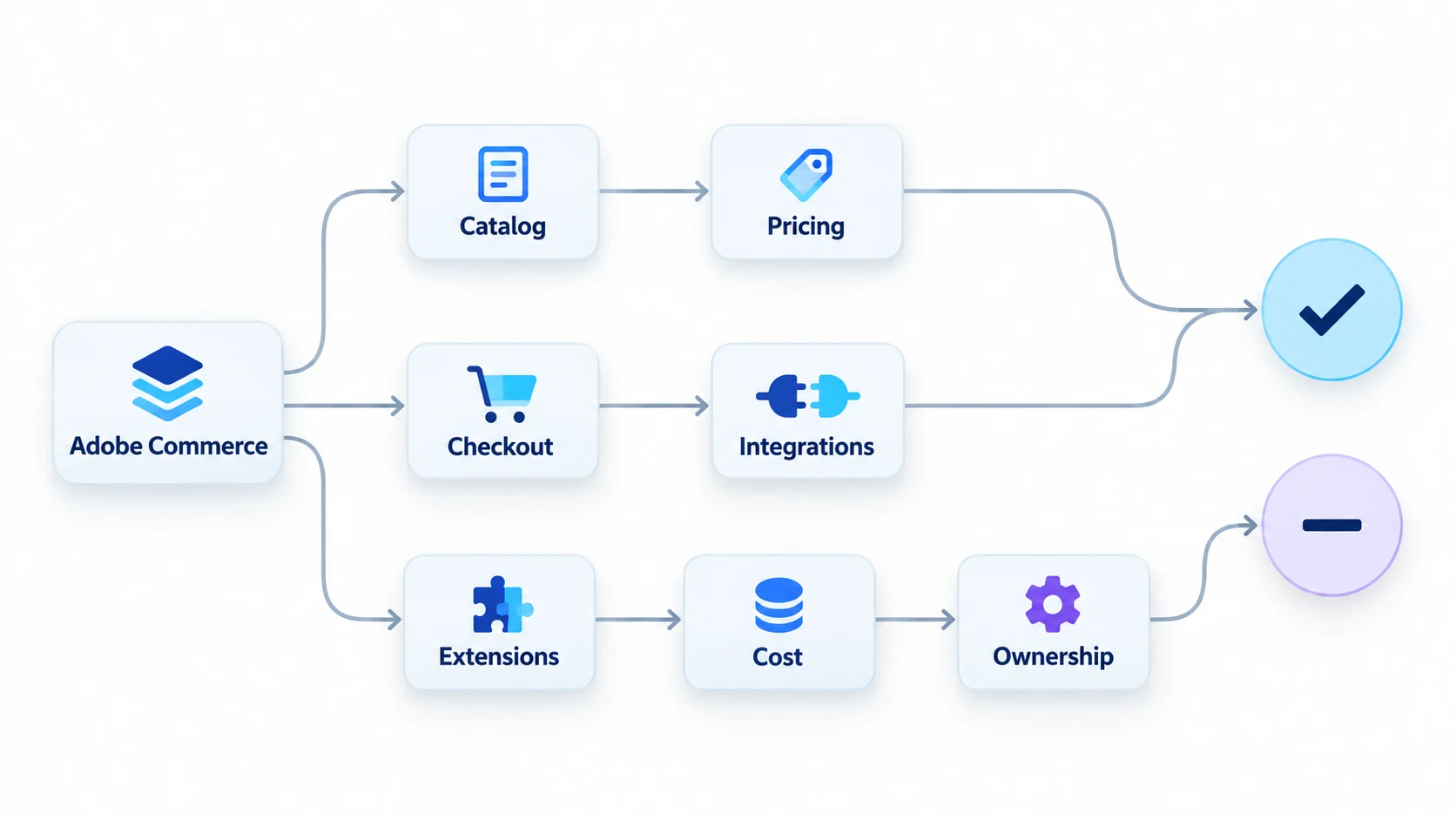
Compare editions against documented requirements and total cost. Do not assume the licensed edition removes the need for architecture, development, testing, monitoring, or upgrades. Conversely, do not assume recreating enterprise capabilities with extensions is cheaper.
Architecture decisions that matter
Extension strategy
Every extension adds code, dependencies, configuration, and upgrade risk. Evaluate vendor quality, support, security history, performance, and overlap with existing modules. Prefer a small set of well-maintained extensions over a large collection of shortcuts.
Custom modules should follow Magento service contracts, dependency injection, event, and extension mechanisms. Direct modifications to core code make security updates and upgrades unnecessarily difficult.
Data ownership and integrations
Define whether Magento, ERP, PIM, OMS, or another service owns products, prices, inventory, customers, and orders. Integration design should include validation, retries, idempotency, reconciliation, alerting, and recovery—not only a mapping of API fields.
Use asynchronous processing when real-time coupling would make the storefront dependent on slow back-office systems. Customers need accurate promises, but checkout should not fail because an unrelated system is temporarily unavailable.
Storefront architecture
Magento can serve a traditional theme, a progressive storefront, or a headless frontend. A traditional approach is often simpler to operate. Headless can support distinctive experiences and multiple channels, but it adds API, caching, preview, deployment, and observability concerns.
Choose headless because the customer experience and organizational model justify it—not because it sounds more modern.
Performance and scalability
Magento performance depends on application code, database behavior, indexing, cache configuration, search, infrastructure, media delivery, and third-party scripts. Scaling infrastructure cannot compensate indefinitely for inefficient queries or poorly designed extensions.
Set measurable budgets for key pages and APIs. Test realistic catalogs, customer groups, promotions, concurrent sessions, and order volume. Monitor server latency, cache effectiveness, queue backlogs, errors, and frontend Core Web Vitals. The performance and reliability service covers diagnosis across these layers rather than a theme-only speed fix.
Operational readiness should include deployment automation, rollback procedures, backups, security patching, log aggregation, alerting, and capacity planning for campaigns.
Security and maintenance
Magento’s flexibility creates responsibility. Keep the platform, dependencies, extensions, and infrastructure patched. Restrict administration access, use multi-factor authentication, protect secrets, review custom code, and monitor suspicious account and checkout activity.
Plan upgrades as ongoing product work. Delaying them for years compounds dependency conflicts and makes later migration more expensive.
A reliable Magento development process
- Map business workflows and platform constraints.
- Audit catalog, data quality, integrations, and migration volume.
- Decide edition, hosting, storefront, search, and extension strategy.
- Prototype uncertain workflows and integrations.
- Build complete customer journeys in controlled increments.
- Automate testing for pricing, promotions, checkout, and order state.
- Run security, accessibility, performance, and migration rehearsals.
- Launch with monitoring, rollback, and support ownership in place.
How to choose a Magento development company
Ask a prospective Magento eCommerce development agency to explain its upgrade strategy, extension-review process, performance testing, deployment workflow, and integration failure handling. Review experience with requirements similar to yours, not only visually similar stores.
Confirm which developers and architects will work on the project, who owns infrastructure, how quality is measured, and what support is available after launch. Certification is useful evidence of platform knowledge, but it does not replace sound engineering judgment.
Flexor provides Magento and Adobe Commerce development within its broader platform engineering practice. Review all eCommerce development services and learn about the team when evaluating a Magento partner.
Magento Open Source vs Adobe Commerce
| Criterion | Magento Open Source | Adobe Commerce |
|---|---|---|
| Licensing | No commerce license fee | Commercial license |
| B2B capabilities | Usually custom or extension-led | Native B2B feature set |
| Cloud tooling | Team-owned hosting and operations | Adobe-managed options available |
| Best fit | Controlled custom build | Complex enterprise commerce |